Biomedical Engineering, Medicine, Public Health, Open Source, Structural Solutions
16099 stories
·
228 followers

Using Sound Waves To Make Espresso Could Cut Coffee-Brewing Energy Use By 75%

2 Shares
Researchers developed an ultrasonic espresso process that uses high-frequency sound waves instead of hot water to produce espresso-strength coffee at room temperature. And, not only did coffee drinkers find it comparable to traditional espresso, but the brewing process cut energy use by up to 75%. An anonymous reader quotes a report from The Conversation: We have developed what we call an ultrasonic espresso: a room-temperature brewing process that uses high-frequency sound waves to extract the flavor, oils, aroma and caffeine from coffee grounds. The result is an espresso-strength coffee made in under three minutes, but needing far less energy than the conventional method. Saving up to 75% of energy by not heating the water is a minor benefit for home users or small coffee shops. But for companies making ready-to-drink coffee products at industrial scale, it could be very significant indeed. A concentrated room-temperature coffee could be used directly in bottled drinks, milk-based beverages or cold coffee products. It can also be shipped as a concentrate and diluted later. This would reduce not only energy use, but potentially processing time as well. The key to the new process is ultrasound. These are sound waves above the range of human hearing. In our system, a small metal device called a transducer presses against the side of a traditional espresso basket and makes it vibrate rapidly. Those vibrations move through the water and coffee grounds. This creates a phenomenon known as acoustic cavitation. Tiny bubbles form and collapse in the liquid. When these bubbles collapse near coffee particles, they produce microscopic jets and forces that act a little like scrubbing brushes. They pit and fracture the surface of the coffee grounds, helping flavor compounds, oils and caffeine move into the water much faster than they normally would at room temperature. In other words, ultrasound helps us replace heat with mechanical energy. [...] In earlier work, we used ultrasound to speed up cold brew dramatically. But the challenge in this project was different: could we produce something with the strength, body and intensity of espresso, without heating the water? To do that, we adjusted several variables. Brew ratio was one of the most important: how much water we used for each gram of coffee. Too much water and the drink becomes diluted; too little and extraction becomes difficult. Grind size also mattered. Finer grounds allowed us to extract flavor more rapidly. Finally, we tested how long the ultrasound should be applied. We found the sweet spot was about two-and-a-half to three minutes. Of course, making a concentrated coffee in the laboratory is one thing. The real test is whether people want to drink it. [...] For the espresso samples, participants could not reliably tell the traditional and ultrasonic versions apart. There were no significant differences in aroma, flavor, bitterness or overall liking. For filter coffee, the ultrasound version was actually preferred overall, with participants rating its bitterness more pleasantly.

Read more of this story at Slashdot.

Read the whole story
satadru
5 hours ago
reply
New York, NY
Share this story
Delete

SMPTE Opens Entire Standards Catalog for Free, Removing Century-Old Paywall

1 Share
The Society of Motion Picture and Television Engineers has published over 800 technical standards over the years (as a professional association for the media and entertainment industry). But this week SMPTE "announced that its complete Standards catalog, the technical backbone behind everything from SDI and timecode to IP-based broadcast workflows, is now freely available to anyone in the global media technology community," reports the filmmaking news site CineD, arguing it's "one of the more meaningful structural shifts we have seen from a standards body in years" that could "reshape how smaller developers and educators engage with professional media technology." The move covers all published Standards, Recommended Practices, Engineering Guidelines and Registered Disclosure Documents, plus every future release, ending a long-standing model in which individual documents often sold for well over $100 each. For more than a century, SMPTE Standards have quietly governed how images and sound move through the production chain. If you have ever recorded timecode in the HH:MM:SS:FF format, routed a signal over 3G-SDI, or built a facility around the ST 2110 suite for media over IP, you have relied on SMPTE specifications, whether you knew it or not... Until now, accessing the actual text of those documents usually meant paying per file, a barrier that this announcement removes entirely... The latest releases are available through the Recently Published Documents page on the SMPTE website, with the complete archive reachable through the SMPTE Standards Library... There is also a practical, behind-the-scenes story here. The open-access move is part of a broader modernization of how SMPTE develops and publishes Standards. Recent initiatives include adopting GitHub-based workflows for version control, issue tracking and automation, transitioning to structured HTML-based authoring, and implementing an integrated publishing pipeline that streamlines document creation, review, validation and release... The most consequential beneficiaries are arguably not the large members already inside the system, but the developers, integrators, educators and manufacturers who previously worked around the paywall... The practical upshot is that developers and emerging markets can build from accurate primary specifications rather than secondhand sources, which matters enormously when a single misread tolerance or metadata field can break compatibility down the line. This also fits a wider pattern of the industry moving toward openness. We have previously covered moments like GoPro's decision to make its CineForm codec open source and release the SDK, a codec that SMPTE itself standardized in 2015 as an open standard for acquisition and post production. Lowering the cost of knowledge tends to widen the pool of people who can contribute to it, and a freely readable standards library is a significant step in that direction for an organization that has historically sat behind a per-document fee. "This was a decision we did not make lightly," says SMPTE President Rich Welsh. But "For 110 years, SMPTE has evolved alongside the media technology industry, helping to drive change and innovation — and we're not stopping now." "Our industry is confronting transformative shifts, from IP-based workflows to AI authenticity and content provenance, and we find ourselves at another inflection point. We listened to our Members, Partners and the global Standards community, and the answer was clear: Interoperability is essential to the future of media. Now is the time to open the gates and ensure the next generation of media technology is built on a stronger, more accessible foundation." Thanks to innocent_white_lamb (Slashdot reader #151,825) for sharing the news.

Read more of this story at Slashdot.

Read the whole story
satadru
5 hours ago
reply
New York, NY
Share this story
Delete

Polymarket Paid Dozens to Post Videos of Themselves 'Winning' With Fake Bets

1 Comment and 2 Shares
In January a college student posted a video showing him winning $100,000 on Polymarket — one of 145 that appeared to show bets adding up to almost $410,000, reports the Wall Street Journal. "But none of those bets were real." Instead its creator was "one of dozens of mostly college-age creators Polymarket paid to film themselves making fake trades and sometimes scoring fake wins," the Journal reports, citing interviews with the creators an an analysis of more than 1,100 of their videos: Polymarket built near-perfect copies of its website, then instructed creators to make simulated trades on those dummy sites and hide that they were being paid by Polymarket. To get the videos to go viral, Polymarket has recruited a social-media army to copy and re-post creators' footage. Though the New York-based company has been banned from offering its primary crypto platform in the U.S. since 2022, the social-media creators are paid to specifically target U.S. users, who can still access the site with a virtual private network... Polymarket hired and worked closely with a marketing contractor to promote the site. In a message reviewed by the Journal, that contractor told its social-media army to repost content made by 10 Polymarket creators in particular... These creators didn't initially identify themselves as paid by Polymarket, although one offered a $20 bonus code in his social-media bio... The company instructed creators not to disclose they are paid, according to creators who have worked with the company. They said the pay often added up to $2,000 to $3,000 a month... A handful of videos the Journal reviewed also contained short glimpses of URLs indicating the sites were test environments for Polymarket engineers... Creators said they send the finished videos to Polymarket for review. If a video isn't engaging enough, or if it bears obvious signs of being faked, Polymarket will ask for the videos to be reshot, the creators said... Polymarket sends creators bullet-point guidance on what to say, according to creators who have worked with the company and a recruiting website... Polymarket's viral clipping campaign racked up more than 140 million views on TikTok, YouTube and Instagram, according to the analytics provider Tubular... Internal materials show that Polymarket and Virality promote videos showing how easy it is to conduct insider trades on the platform. Polymarket has paid clippers to promote at least 19 videos discussing opportunities to use inside information or other tactics to manipulate markets. America's advertising laws "require people who are paid to endorse a product to disclose their ties," the article notes, "although there is some gray area about what's permitted." (After the Journal's investigation, the creators started adding "@polymarket partner" to their bios, the article points out._ And when asked for a comment, Polymarket "said it plans to conduct a comprehensive audit of active promotional content."

Read more of this story at Slashdot.

Read the whole story
satadru
5 hours ago
reply
Straight to jail.
New York, NY
Share this story
Delete

Seeing the World in Radio Waves with the QuadRF

1 Comment
A drone is shown flying above some trees and a building. A pink cloud of dots appears above the drone, and a purple cloud below the drone. Grey crosshairs are to the right of the drone.

Although the basic principle of radio direction finding is easy to understand (measure the phase difference between different antennas, then calculate the angle of arrival from this difference), the radio hardware to actually implement this has historically been hard for hackers to access. The QuadRF project aims to change this by building a phase-coherent four-channel SDR which makes direction mapping easy (GitHub repository).

The QuadRF uses two boards: one to receive and pre-process radio waves, and a Raspberry Pi 5 for additional processing. The RF board has four patch antennas, each capable of either transmitting or receiving in the 4.9 GHz to 6.0 GHz range, with switchable right- or left-hand polarization. For on-device processing, it uses a Lattice ECP5 FPGA, which uses two MIPI cables to connect to the camera and display interfaces on the Raspberry Pi. These form a very high-speed data exchange, and after further processing, the Pi can pass data on over Ethernet or Wi-Fi. Individual QuadRF boards can connect together in a lattice grid to form larger phased arrays.

The QuadRF’s software shows off its real strength: it’s compatible with standard programs like GNU Radio, but it also hosts a few of its own programs. The most striking of these is an “RF camera” which scans its entire frequency range at 30 fps, tracking the direction of detected signals and visualizing them on a spatial plot. When overlaid on a camera feed, this plot lets one easily see the radio signals emitted from electronics; as an example, the creators tracked a drone in flight, even distinguishing the two radio transmitters on the drone.

This isn’t the first multi-antenna SDR we’ve seen, though this is the first that could transmit. It’s important to be careful, though: some applications of this kind of hardware run afoul of arms regulations.

Thanks to [Swake] for the tip!

Read the whole story
satadru
5 hours ago
reply
Tune this to police radio frequencies and this might be even better than a radar-detector!
New York, NY
Share this story
Delete

Autopsy of a Freshly Cooked 10Gbit SFP+ Network Adapter

1 Share

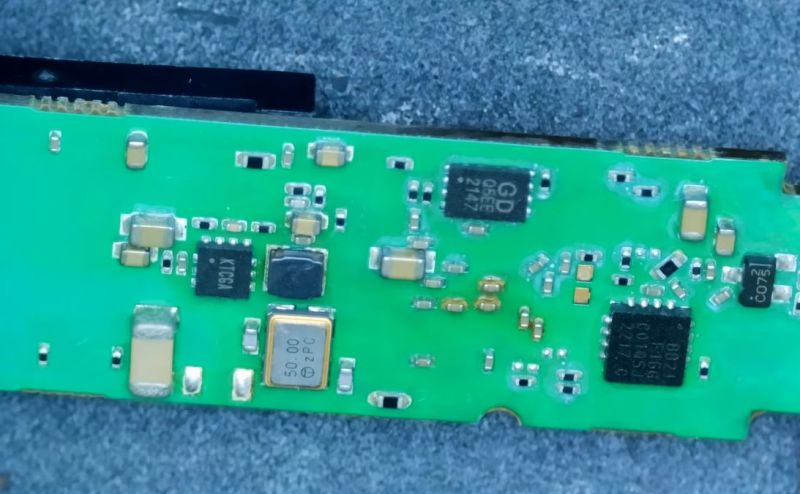
With the advent of affordable 2.5 Gbit, 5 Gbit, and 10 Gbit consumer networking gear, more and more people are taking advantage of these higher networking speeds, with [This Does Not Compute] having used 10 Gbit SFP+ modules over regular Cat-5e copper to connect to a NAS in the next room. Only problem was that after a while these SFP+ modules began to start dropping frames. On taking a closer look at these modules, he found that they were running pretty hot: 40°C while idle. A teardown of one of these modules showed severe discoloration due to heat.

Side view of the SFP+ module's PCB. (Credit: This Does Not Compute, YouTube)
Side view of the SFP+ module’s PCB. (Credit: This Does Not Compute, YouTube)

Inside these 10Gbit modules is the Marvell-branded Alaska X 88X3310/40P PHY, which despite the ‘low-power’ claims have a metal heatsink glued onto the actual IC and thermally coupled to the module’s metal enclosure. The other side of the PCB was quite discolored, further indicating how hot these modules run in operation. Some digging revealed that this can go up to around 2.5 watts.

Perhaps the most fascinating part of this teardown is the discovery of an 8051-based MCU that’s responsible for telling the switch the module is put into that it is a 30-meter multi-mode fiber module, presumably for compatibility purposes. It’s definitely an interesting feature of these FS-branded SFP+ modules.

These old modules were replaced with Wiitek-branded modules that are supposed to use only up to around 1.5 watts in operation courtesy of a newer chipset, in the hope that these wouldn’t fry themselves. At idle these do however still run at 30 °C. As noted in the comments, it might be a good idea to have active airflow over high-speed networking gear like this, as they generally can get pretty hot and sometimes crispy.

The final solution for the video’s networking problem was to just run single-mode fiber to the room and use appropriate SFP+ modules for that, also because these run noticeably cooler. If you still have room in your cable ducts, that would seem to be the optimal solution.

Read the whole story
satadru
6 hours ago
reply
New York, NY
Share this story
Delete

Solid-State Batteries Take to the Sky

1 Comment and 2 Shares

There always seem to be a handful of revolutionary technologies perpetually out of reach: fusion energy, quantum computers, and full self-driving cars are always in this list, and it seems like there’s also some battery technology which will finally let us fully decouple from fossil fuels in there as well. Although lithium batteries have allowed some ground-based electric transportation, the energy density is still not enough to enable full electrification, especially for things like aircraft. Solid state batteries may be on the verge of changing some of this, though, and a team has recently put them to work in a test aircraft to help make some headway with this novel battery chemistry.

The main contributing factor of these batteries’ improved energy densities is the ability to use a solid lithium anode, which has much higher energy density than the graphite-based anodes in modern liquid electrolyte batteries. Solid state batteries also have improved safety, since the solid electrolyte is generally not flammable and the battery itself is less prone to thermal runaway. The tests in this aircraft, a modified motorized glider, bear this out as well. With a standard lithium ion pack the team was able to harness 250 Wh/kg and with their new solid state battery they managed 410 Wh/kg, which let them fly the craft up to 24,000 feet (7,315 m) with the help of some wing-mounted solar panels.

Of course, a motorized glider is a long way away from battery-powered commercial flights, but tests like this are an important step on the way to de-carbonizing one of the more impactful industries on the planet, as well as hopefully making it less expensive to operate aircraft in the way EVs are generally much cheaper to operate than their internal combustion equivalents. But the limiting factor to adopting solid state batteries isn’t going to be implementation but rather the discovery of a cost effective way to manufacture them at scale. It’s the same reason we haven’t seen mass adoption of things like algae-based biodiesel or economic carbon capture yet.

Read the whole story
satadru
2 days ago
reply
Can't wait until these solid-state lithium batteries finally end up in consumer products like the nifty 1.5 V lithium AA batteries available now with built-in buck converters.
New York, NY
sarcozona
1 day ago
reply
Epiphyte City
Share this story
Delete
Next Page of Stories