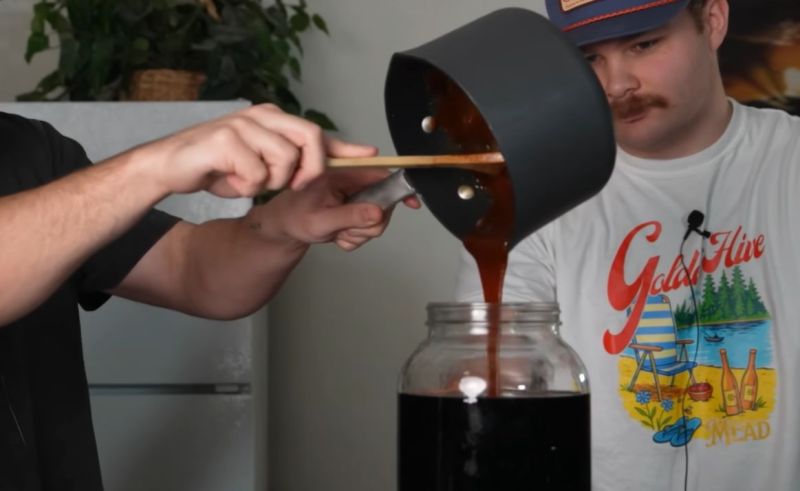
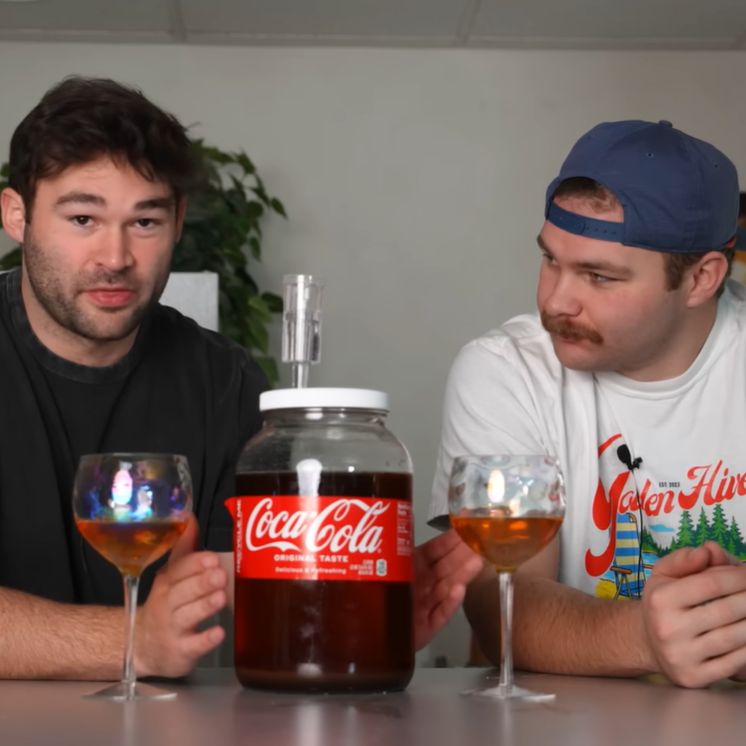
Test tasting soda mead. (Credit: Golden Hive Mead, YouTube)
You can certainly just chug down that bottle of soda you purchased, but if you accept the premise that the preparation of food and drink is just a subset of chemistry, and that chemistry is fun, then it naturally follows that using soda as the basis for brewing up some mead makes perfect sense. Thus the [Golden Hive Mead] blokes over on YouTube decided to create some Coca Cola flavored mead.
Mead is essentially just water mixed with honey that is left to ferment after adding yeast, resulting in what is also called ‘honey wine’, with an ethanol content of usually between 3.5% and 20%. Since soda is mostly water and comes with its own supply of sugar for yeast to feast on, this isn’t such a crazy choice in that respect. Just make sure to remove the carbonation, as the CO2 makes the soda too acidic for the yeast to be happy.
Instead of straight honey, caramelized honey was used for extra flavor after which the brew was left to ferment for a while. For extra flavor notes aged oak, vanilla and cinnamon were added as well, to ensure that the fermentation didn’t erase those core notes of the coke. The result was apparently rather flavorful, with about a 10.5% ethanol content, receiving the full approval of both tame test tasters.
Ionizing radiation damage from electrons, protons and gamma rays will over time damage a CMOS circuit, through e.g. degrading the oxide layer and damaging the lattice structure. For a space-based camera that’s inside a probe orbiting a planet like Jupiter it’s thus a bit of a bummer if this will massively shorted useful observation time before the sensor has been fully degraded. A potential workaround here is by using thermal energy to anneal the damaged part of a CMOS imager.
The first step is to detect damaged pixels by performing a read-out while the sensor is not exposed to light. If a pixel still carries significant current it’s marked as damaged and a high current is passed through it to significantly raise its temperature. For the digital logic part of the circuit a similar approach is used, where the detection of logic errors is cause for a high voltage pulse that should also result in annealing of any damage.
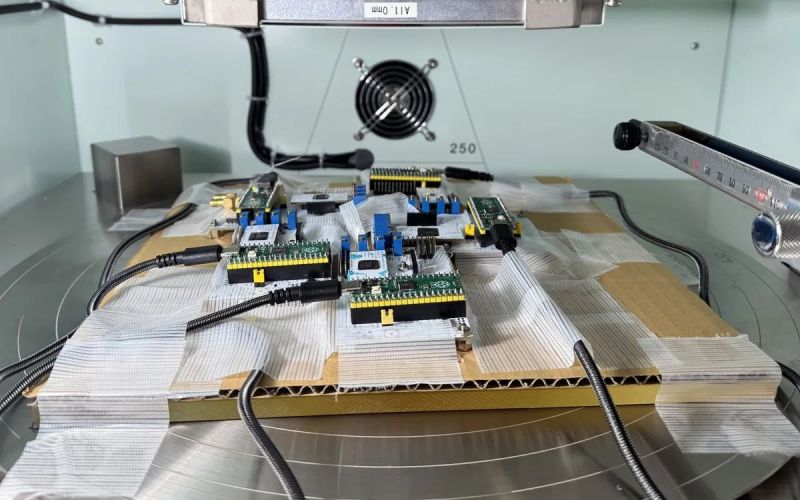
During testing the chip was exposed to the same level of radiation to what it would experience during thirty days in orbit around Jupiter, which rendered the sensor basically unusable with a massive increase in leakage current. After four rounds of annealing the image was almost restored to full health, showing that it is a viable approach.
Naturally, this self-healing method is only intended as another line of defense against ionizing radiation, with radiation shielding and radiation-resistant semiconductor technologies serving as the primary defenses.
Solar power has been around for a long time now. Once upon a time, it was mostly the preserve of research projects and large-scale municipal installations. Eventually, as the technology grew ever cheaper, rooftop solar came along, and cashed-up homeowners rushed to throw panels on their homes to slash their power bills and even make money in some cases.
Those in apartments or rented accommodations had largely been left out of the solar revolution. That was, until the advent of balcony solar. Popular in Germany, but little known in the rest of the world, the concept has brought home power generation to a larger market than ever.
Pop One On
Photovoltaic solar panels were very expensive to manufacture, a long time ago. This made it difficult for solar power to compete with traditional energy sources like fossil fuels. High install costs and limited power output made the business case difficult, even if the energy from the sun itself was effectively free. However, as the desire for cleaner sources of energy ramped up over the years, solar panel production ramped up in turn. Economies of scale did their thing, and panels grew cheap enough for individuals to consider installing them on their own homes. This led to the widespread uptake of rooftop solar, with installations commonly in the 5 kW to 10 kW range with inverter hardware to allow feeding energy back into the grid in a safe and controlled manner.
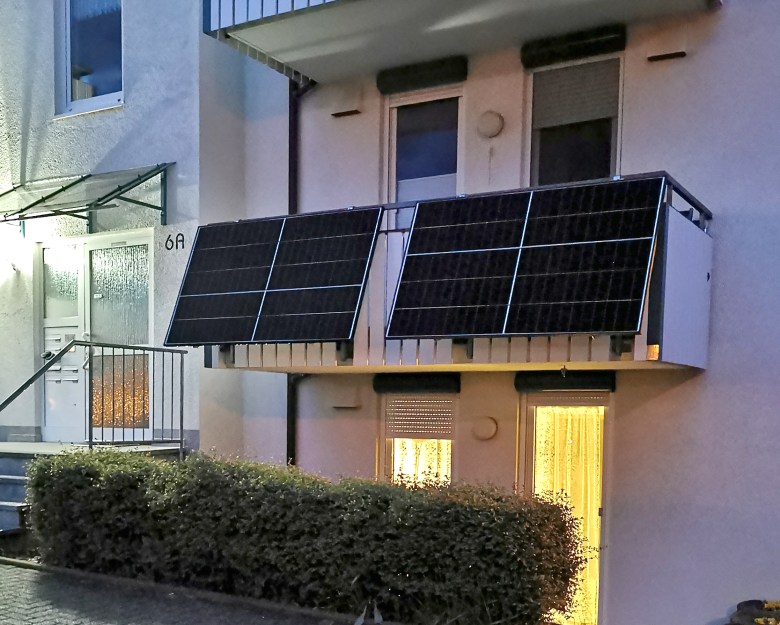
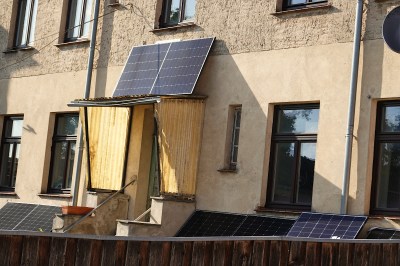
The common term is “balkonkraftwerk” in German, which translates to “balcony power plant.” However, there’s no real need for a balcony. Anywhere you can hang them outside a building will work if you can find a way to route the wires to a power point. Credit: RobbieIanMorrison, CC BY 4.0
The problem with rooftop solar is that not everybody owns their roof. A great many people around the world live in apartments, or rent, and are not in a position to make permanent adjustments to their home. These groups were largely left out of the solar revolution. That was, until solar panels grew so cheap and power bills grew high enough that even small-scale installs started to make financial sense.
In Germany in particular, small solar installs have become quite popular, and the country has become a hotbed for so-called “balcony” solar installations. These involve simple setups of one or two solar panels which are designed to be easily mounted on a balcony or other outdoor area of a home, rather than permanently installed on a rooftop.
They come with small inverters to convert the DC output of the solar panels into AC power, which plug straight into an existing home power socket. This do-it-yourself install method eliminates the need for hiring an electrician, further improving the affordability of the system. The inverters used with these systems include anti-islanding protection so that the solar system does not power any circuits if the grid has been deenergized for service or repair.
Balcony solar does have some limitations compared to rooftop installs. Often, installation angles are imperfect for making the most of the sun available. There are also limitations to how much power you can get out of such a system. Germany’s initial regulations for “balkonkraftwerk” systems stated that feed in power had to be limited to 600 watts to avoid potential issues with household wiring and sockets that were never designed for feed-in solar power.
Updated regulations allow up to 800 watts of feed-in, with an additional regulation that the installed panels do not exceed a level of 2000 watts peak output. It might sound like a mismatch, but it’s possible to use the excess power from the panels to charge a battery when the output exceeds the 800-watt limit. Having larger panels with higher peak output is useful, too, for when the sun isn’t shining so bright. A 2000 watt peak panel setup will be outputting 800 watts or more far more often than a set of panels that only delivers 800 watts in peak conditions.
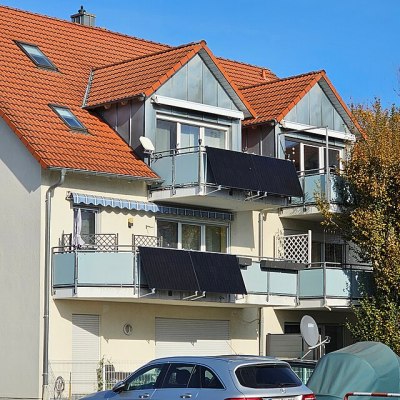
The panels are generally installed in ad-hoc fashion. Credit: Nikolai Twin, CC BY 4.0
Despite the limitations, or perhaps because of them, it’s a cinch to get yourself going with solar in Germany. Just head to your local big box store, purchase a kit, and hang it off the side of your house. Once you plug it in to the wall, you’re pretty much done. Most kits come with some sort of app for monitoring the system so you can keep an eye on how much your panels are generating. The ease of access has led to an explosion in installs, with over 1 million balcony solar setups already operating in the country.
Thus far, balcony solar has been largely a German thing. However, other parts of the world are catching on. Other European nations like Spain, France, and Belgium have all got on board the train already. In the United States, the state of Utah has already approved a framework for balcony solar installs, and Virginia is following close behind. The key has been carving out special measures to allow easy, cheap DIY installs for small solar systems.
Typically, setting up rooftop solar in most states requires signing an agreement with the local utility regarding power feed-in to the grid, as well as hiring professional contractors for the installation. This adds a huge amount of cost which a small solar system would never recoup in a reasonable amount of time. By eliminating these hurdles for small-scale plug-in setups, they become viable and far more accessible to more of the community.
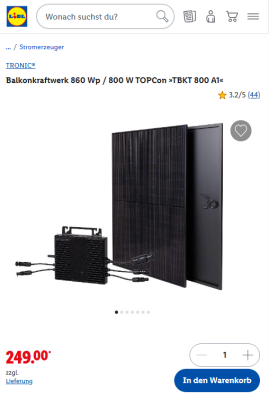
Balcony solar kits are readily available at stores across Germany. An 800-watt kit can be had for as little as a few hundred Euros. Credit: Lidl via screenshot
Balcony solar is unlikely to be an instant gamechanger that drastically shakes up the power grid. Most installs are low power. Their juice is mostly sucked up to run a fridge and a TV or two, and few make major feed-in contributions to the broader grid. However, their popularity in Europe shows that there is a serious eagerness amongst the broader community to get on board the solar train any which way or how. At the very least, balcony solar is a grand business opportunity and one that is bringing sustainability to more corners of the urban and suburban landscape than ever before.
A few weeks ago I shipped NewsBlur v14 for iOS and Mac, a major redesign of the Apple apps. Today, Android gets the same treatment. Every screen has been reworked: the feed list, the story list, the reading view, preferences, and menus. Along with the visual overhaul, several features that were previously web-only are now on Android: Ask AI, Discover Related Sites, and the Daily Briefing.
Here’s what’s new.
Ask AI
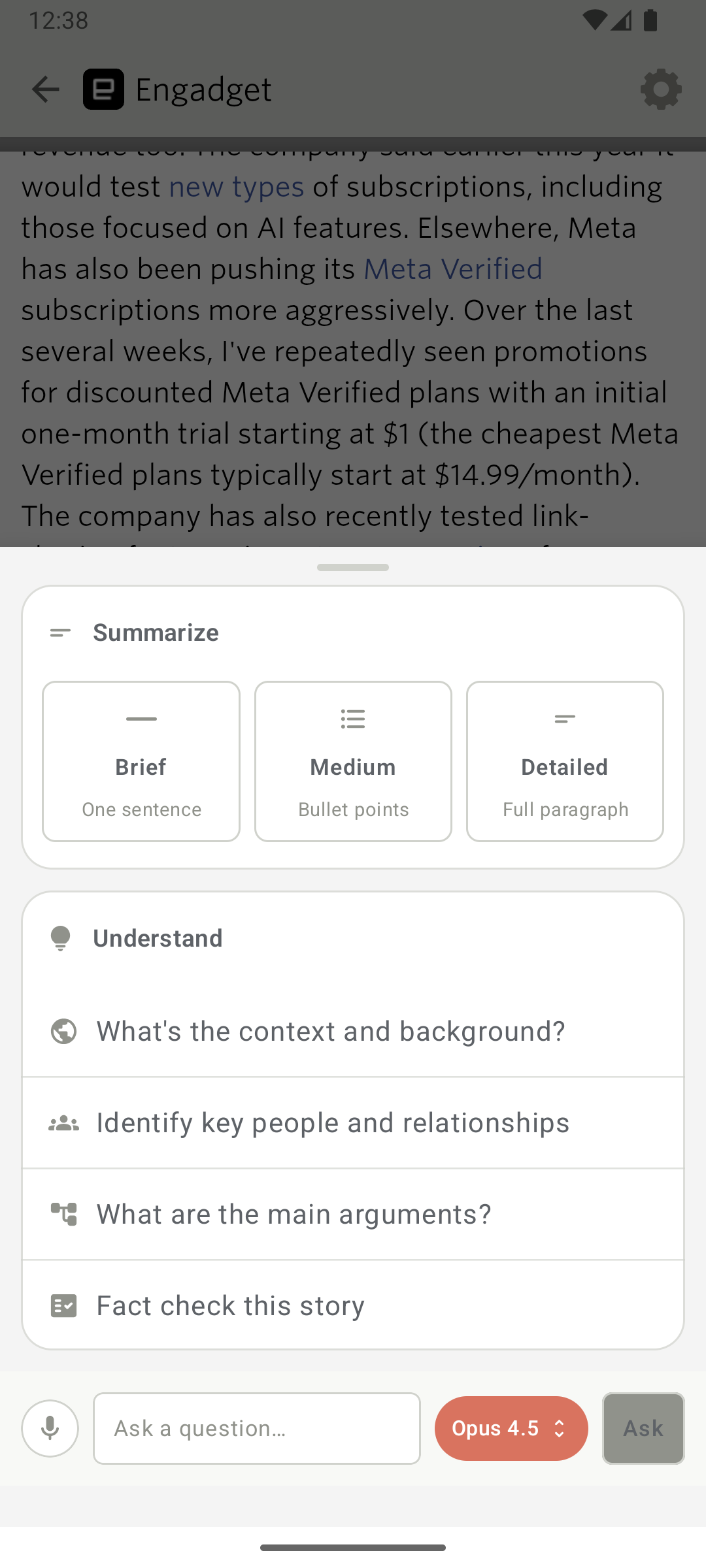
Ask AI brings the same AI-powered Q&A from the web and iOS to Android. Open any story, tap Ask AI, and ask questions about it. Summarize a long article, get background on a developing situation, or fact-check a claim. Pick your preferred AI model and keep the conversation going with follow-ups. The Ask AI sheet matches your current theme and slides up as a bottom sheet, consistent with the share and trainer dialogs.
Discover related sites
Discover Related Sites lets you find new feeds related to any feed you’re already subscribed to. Tap the Discover button in the story list header bar, browse what’s available, and preview a feed before subscribing. Duplicate feeds are filtered out so you only see new options.
Daily Briefing
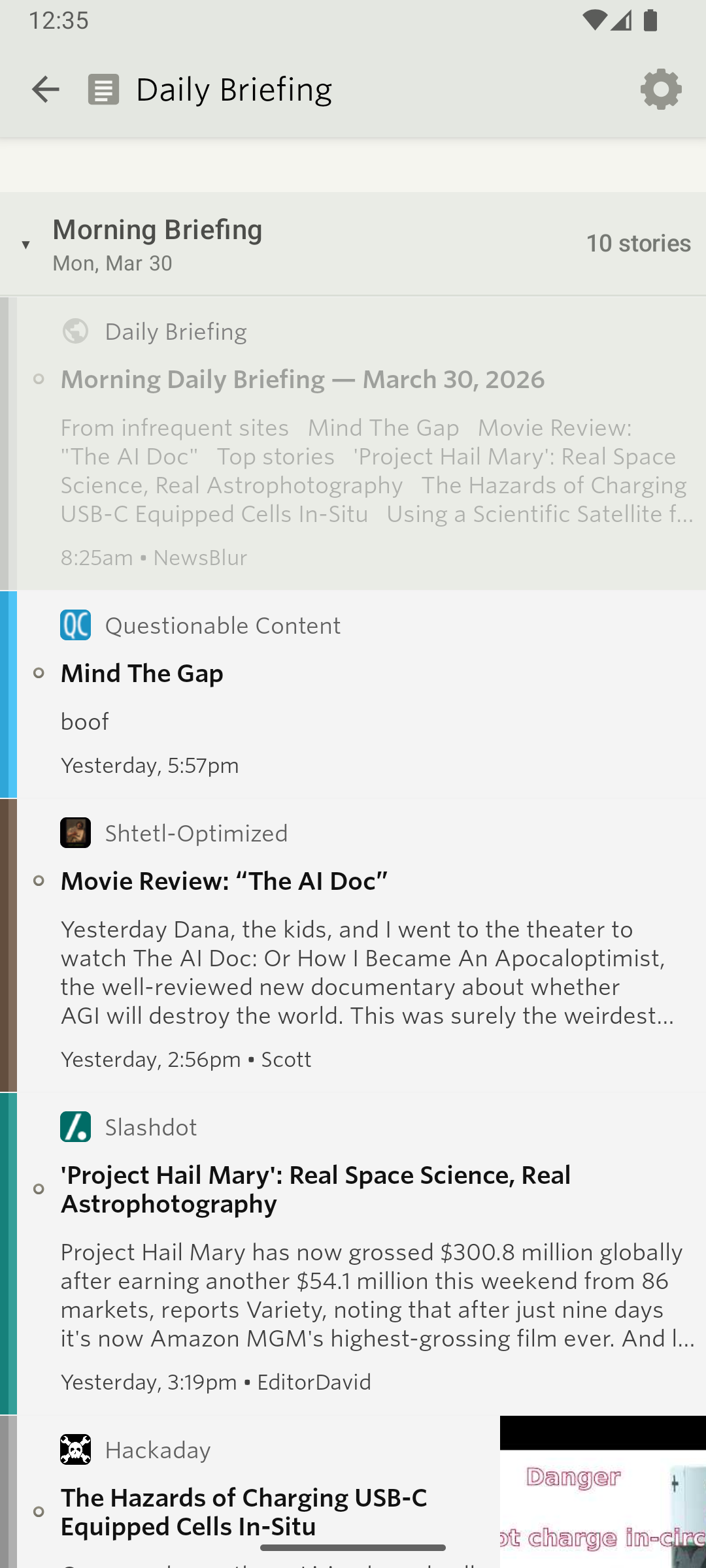
The Daily Briefing generates a personalized summary of your news, organized into sections like Top Stories, Based on Your Interests, and Long Reads. It uses native Android story rows, so it feels like a regular feed rather than a bolted-on feature. Configure your briefing frequency, writing style, and sections from the briefing view in your sidebar.
Sepia theme and refined dark themes
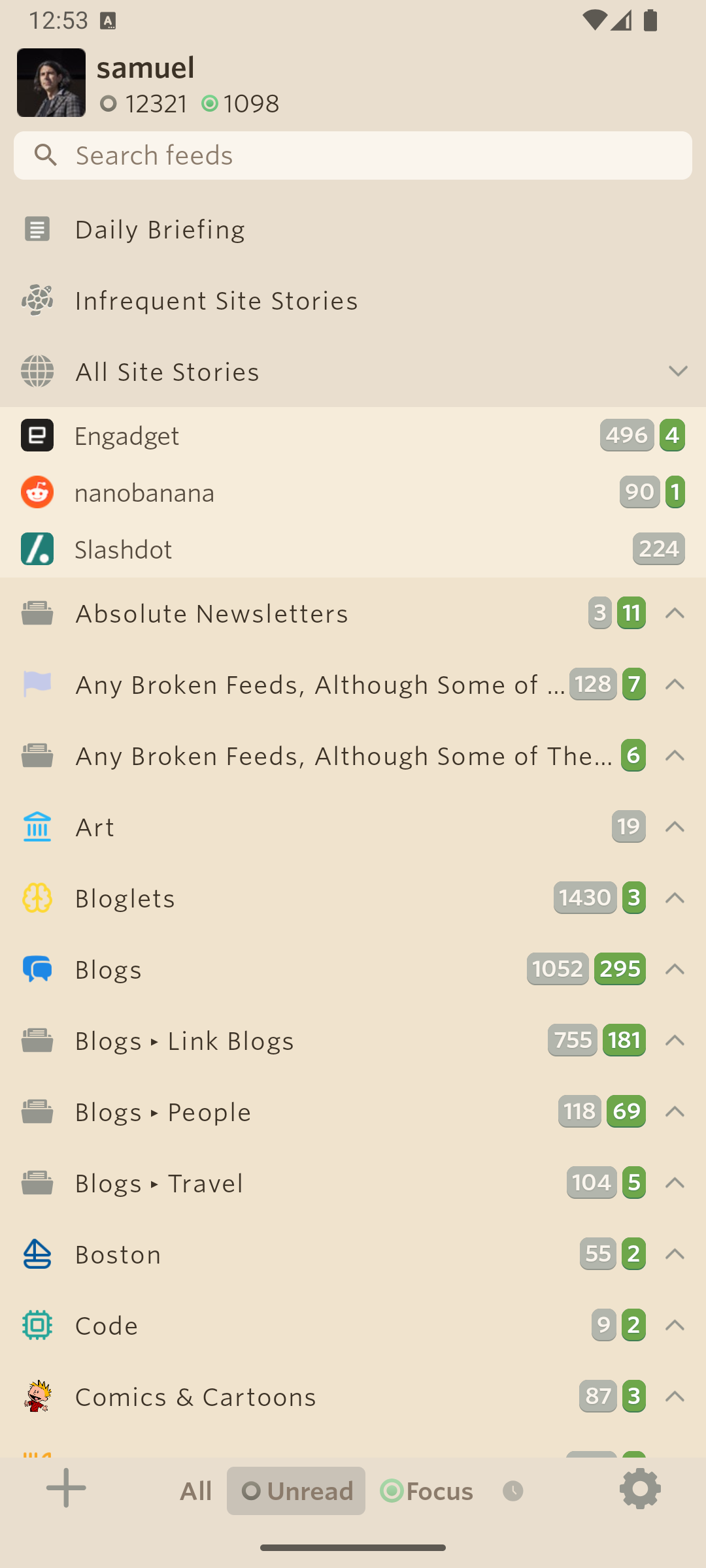
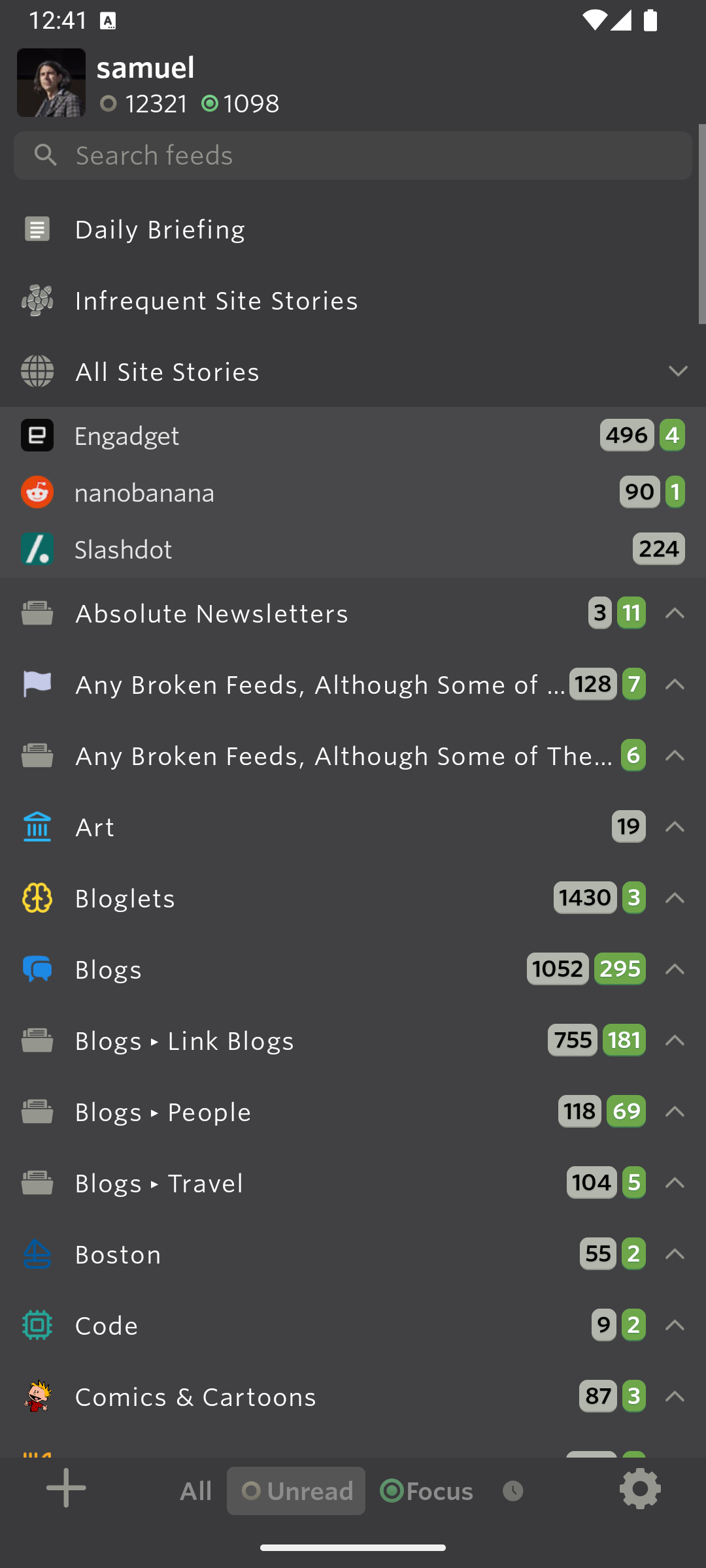
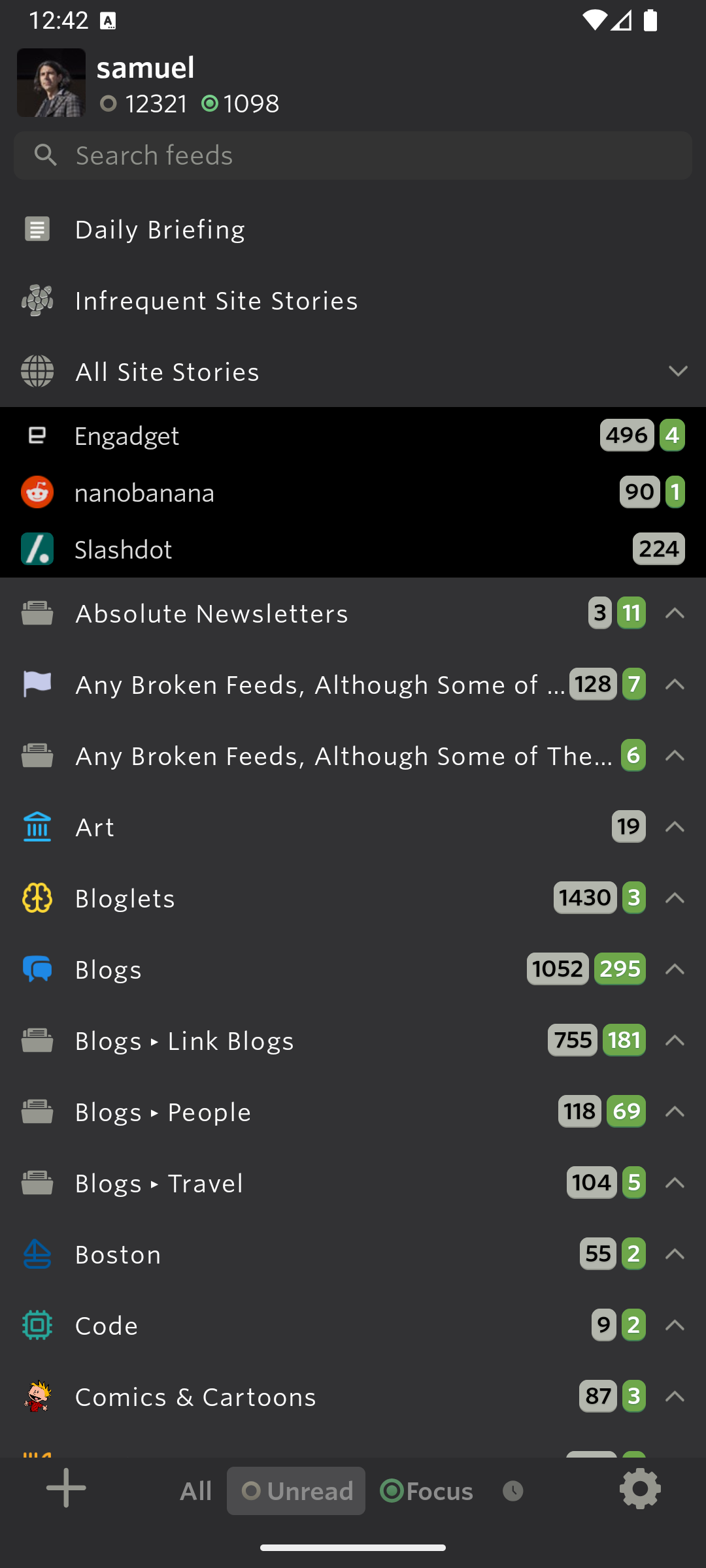
A new Sepia theme brings warmer tones for comfortable long reading sessions. The Dark theme has been lightened to match the iOS gray/medium palette, and the Black theme now uses true absolute black backgrounds for feed and story cells, making it ideal for OLED screens.
Story list header bar
The top of the story list now has a header bar with quick access to Discover, search, display options, and settings. The display and settings controls are split into separate menus so you can change the view without wading through unrelated options.
Redesigned reading experience
The reading view has been rethought from top to bottom. Story traversal buttons are lifted above the bottom edge for easier thumb access. A new traverse bar with refined icons shows your position and unread count. Story actions are hidden until the story finishes rendering, so you never tap a button before the content is ready. Opening a story from the list now animates smoothly into the reader, and swiping back uses an interactive gesture that tracks your finger.
Redesigned preferences and menus
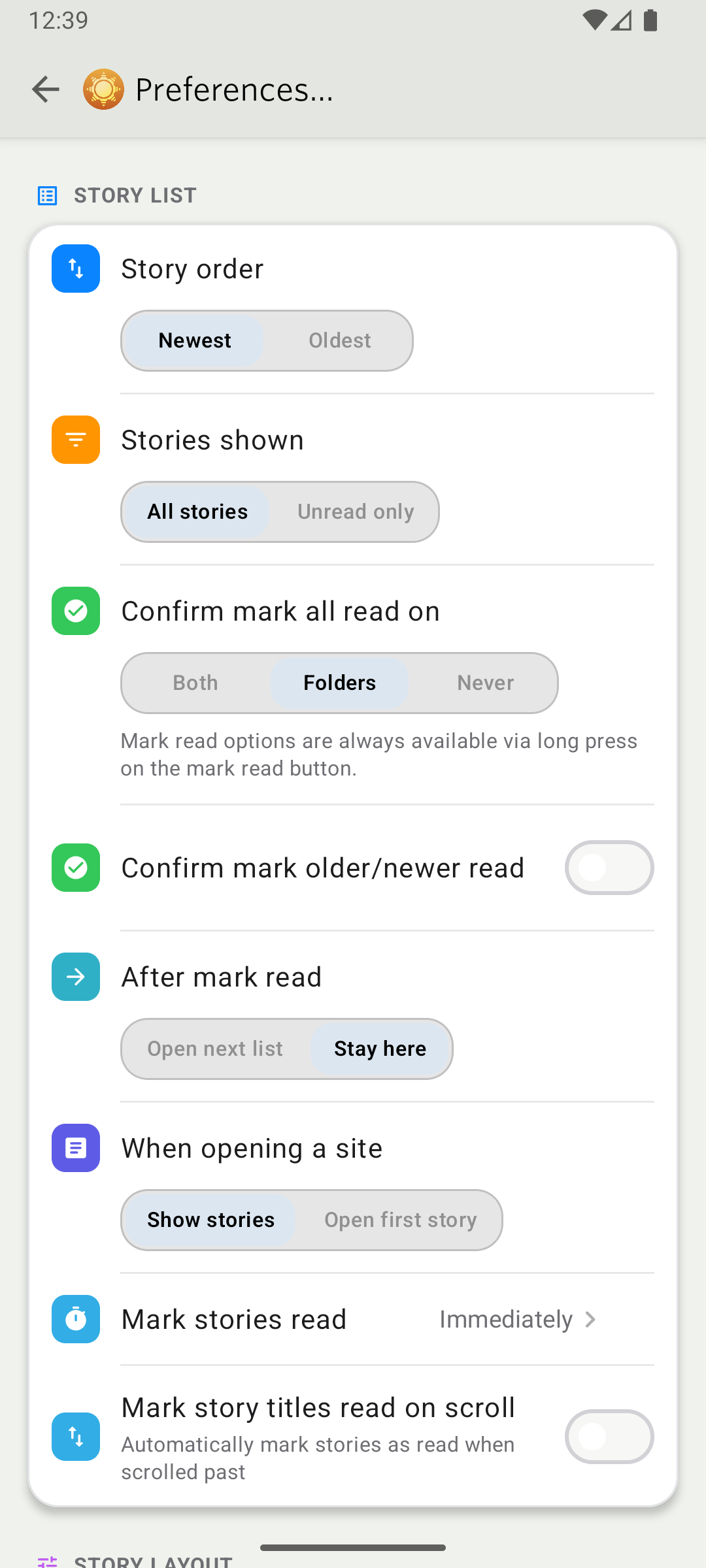
Preferences have been rebuilt as a modern settings screen with inline segments instead of separate dialog pickers. The feed list menu, reading menu, and folder menus have all been redesigned with cleaner styling and better organization. Menus now scale with your device font size, so they stay readable at any accessibility setting.
Premium Archive and Pro subscriptions
You can now subscribe to Premium Archive and Premium Pro directly from the Android app. An upgrade banner appears in the story list when you’re on a lower tier, showing what you’d unlock by upgrading.
Everything else
Beyond the headline features, this release includes a long list of improvements and fixes.
Improvements
Interactive swipe-back gesture in both the story list and reading view with predictive back support on Android 14+.
Feed list aligned with iOS styling, with new collapse-all and expand-all toggles.
Story header pills with compact layout and title case formatting.
Active reading time tracking per story, synced to your account.
Full text and regex classifiers for the Intelligence Trainer.
Feed search field themed to match your current theme with autofill disabled.
Sync done pill delayed until feeds actually render, so you see the update happen.
Story thumbnails enlarged for small sizes and cropping fixed.
Status banners at the top of the story list for loading and error states.
Mute Sites redesigned with upgrade card and progress bar.
Custom folder and feed icon support.
Fixes
Fixed TransactionTooLargeException crash in the reading pager.
Fixed database version mismatch crash on launch.
Fixed ItemListMenuPopup crash on small and split-screen displays.
Fixed login autofill and app switching losing input.
Fixed story row thumbnail cropping.
Fixed search pill text vanishing.
Fixed story list edge back gesture interference.
Brightened story feed titles for better readability.
Coming up next: v14.2 will bring story clustering to Android, so duplicate stories across your feeds get grouped together automatically, just like on the web.
NewsBlur v14 for Android is available now on the Google Play Store. If you have feedback or run into issues, I’d love to hear about it on the NewsBlur forum.
Hershey said Wednesday it will use classic recipes for all Reese’s products starting next year, a change that comes after the grandson of Reese’s founder criticized the company for shifting to cheaper ingredients.
Why do so many people keep falling for the same trick over and over again?
With an over $400 billion gap between the money invested in AI data centers and the actual revenue these products generate, Silicon Valley slowly returned to the tested and trusted playbook: advertising.
Now, ads are starting to appear in pull requests generated by Copilot. According to Melbourne-based software developer Zach Manson, a team member used the AI to fix a simple typo in a pull request. Copilot did the job, but it also took the liberty of editing the PR’s description to include this message: “⚡ Quickly spin up Copilot coding agent tasks from anywhere on your macOS or Windows machine with Raycast.”
It turns out that Microsoft has added ads to over 1.5 million Copilot pull requests on GitHub, and they’re even appearing on GitLab, one of the GitHub alternatives. The reasoning is clear, too, of course: “AI” companies and investors have poured ungodly amounts of money in “AI” that is impossible to recover, even with paying customers. As such, the logical next step is ads, and many “AI” companies are already starting to add advertising to their pachinko machines. It was only a matter of time before Copilot would start inserting ads into the pull requests it ejaculates over all kinds of projects.
This isn’t the first time a once-free service turns on its users, but it’s definitely one of the quickest turnarounds I’ve ever seen. Usually it takes much longer before companies reach the stage of putting ads in their products to plug any financial bleeding, but with the amount of money poured into this useless black hole, it really shouldn’t be surprising we’re already there. I’m sure Copilot’s competitors, like Claude, will soon follow suit.
They’re enshittifying Git, and developers are just letting it happen. No wonder worker exploitation is so rampant in Silicon Valley.
 Log in