Biomedical Engineering, Medicine, Public Health, Open Source, Structural Solutions
16134 stories
·
228 followers

Social Media Bans Aren’t Enough to Make Children Safe

1 Comment


Even before France approved legislation banning social media for children under 15 last January, 13-year-old Benjamin was already wondering what life without social media would look like. “If we want to play football, we won’t be able to organize it. What will we do? Send letters instead?” he joked in an interview for Le Monde.

His reaction captured the central challenge behind the growing wave of youth social media bans: Removing access is one thing; understanding what those platforms mean in children’s lives is another.

Within weeks of Australia’s similar ban, the country’s eSafety Commissioner reported that platforms had restricted access to 4.7 million under-16 accounts. Two months later, though, one in five Australian teenagers under 16 was still using TikTok and Snapchat, according to a parental-control data company. But even if all children’s social media accounts were to disappear, do such bans actually make children safer online?

Governments are moving ahead without answering that question as they follow Australia’s lead. Indonesia’s child-safety framework, which took effect in March, bars children under 16 from holding accounts on “high-risk” platforms. The U.K. government has announced plans to ban social media for under-16s, add default overnight social media curfews for 16- and 17-year-olds, and extend child-safety rules to cover risky AI features. And on 17 September, the European Commission proposed the EU KIDS Act, which would bar children under 13 from social media, set 15 as the EU-wide minimum age for opening an account independently, and require platforms to show that their services are age appropriate and safe by design.

But based on my experience working on Child Online Protection initiatives with the International Telecommunication Union (ITU) across Southeast Asia and the Pacific, I know the bans don’t address the real problems. Instead, we should be paying more attention to the systems that generate harm in the first place—namely, recommender algorithms, engagement-maximizing design, opaque moderation, and extractive data practices.

Account removals are not the same as online child safety

My experience working on protecting children’s online safety has taught me three main lessons:

First, the public institutions responsible for child online protection often lack the staff, budget, or technical capacity to enforce complex online safety policies.

Indonesia is illustrative. A 2026 UNICEF evaluation found capacity constraints among service providers, long-term funding uncertainty, and a need for specialized personnel. At the local level, some staff lacked digital skills, while budget constraints left some areas reliant on external support.

Second, many children, and often their parents, lack the digital literacy and critical thinking skills needed to navigate online risks safely. My policy research on child online protection in Indonesia, published earlier this year in Digital Society, found substantial gaps that account removals cannot repair: Many children lacked guidance on navigating the internet safely, and large numbers did not know how to report harmful experiences.

And third, the platforms have limited independent oversight as they identify underage users, design age-verification systems, and report their own compliance. In Indonesia, platforms themselves are responsible for carrying out age verification, while the Ministry of Communication and Digital Affairs oversees compliance. TikTok’s appeals process for users flagged as underage, for instance, can require a government-issued ID and selfies, which is a problem because it involves collecting the additional personal data on an ID card, beyond that needed to confirm age. Will government regulators ensure that TikTok handles that data responsibly?

The privacy paradox of proving age

Every age-based ban creates an engineering problem: How can a platform reliably determine that a user is old enough, without intruding on other information? Governments and companies may use identity documents, parental authorization, app-store checks, or facial age estimation. Each approach has trade-offs among accuracy, privacy, accessibility, and resistance to circumvention.

There are also technical issues. One tool, facial age estimation, draws on enormous databases but it is probabilistic, not exact, because people vary so much. It’s also been shown to misclassify both children and adults.

The challenge should not merely be to “verify age.” It should be to prove that someone is above a threshold, without disclosing their identity, birth date, or other information third parties might use to create a marketing profile. The European Commission’s age-verification blueprint challenges companies to verify ages without collecting all that additional information.

Privacy-preserving technologies offer promising ways to achieve this. Zero-Knowledge Proofs (ZKPs) can confirm that someone meets an age threshold without revealing their identity or exact date of birth. W3C Verifiable Credentials are cryptographically verifiable digital claims that can disclose only the information needed, such as “over 16.” And device-based age signals can allow a phone or app store to share an age range without revealing a user’s exact birth date. But these methods still require rigorous security testing, common standards, independent oversight, and clear limits on data retention. Otherwise, poorly designed child-safety policies risk creating permanent identity infrastructures in which businesses, not people, control personal data.

Where connection goes when a platform closes

Blocking access to a platform redirects some young people, but not always where expected. Early anecdotal reports in Australia pointed to teenagers migrating to smaller, less-regulated platforms like Yope, a pattern the Cato Institute flagged as a “whack-a-mole” problem for regulators. But industry data collected two months later found no broad-based shift of that kind, aside from a small uptick in WhatsApp use. Many teens simply found a way to stay on the banned platforms.

This points to a deeper gap in current society: the erosion of youth “third places“ physical spaces where young people have room to socialize and build identity outside home and school. As those spaces have diminished, commercial communications platforms have absorbed that role.

For many teenagers, social media workarounds are merely inconvenient. But for isolated, marginalized, disabled, or LGBTQ+ youth who depend on online communities for support that’s otherwise unavailable, displacement can mean losing certain kinds of belonging, or having to move to a platform with even weaker oversight.

How to design safer online systems for children

If blanket social media bans don’t work, then what will? The platforms have created many of the conditions that governments are now trying to contain: engagement-optimized recommenders, intrusive data practices, weak safeguards against unwanted contact, and features such as infinite scroll, autoplay, streaks, and persistent notifications.

These design patterns increasingly face regulatory scrutiny, including what’s required under the European Union’s Digital Services Act. A 2026 study from the 5Rights Foundation that tracked children’s device use minute by minute found that the user interfaces shape children’s attention, sleep, and well-being in real time.

A more durable response would regulate those interfaces directly, treating children as legitimate users whose privacy, agency, and well-being are required protections, not afterthoughts. That means designing for safety from the outset. One example would be for children’s apps to have high-privacy defaults, such as private accounts and location sharing switched off for minors. They could also have recommender systems that explain the main factors shaping a feed and give young users more control over personalization. The European Commission has published age-appropriate interaction guidelines that limit unsolicited contact and prevent minors from being added to groups without consent. Rules could also prohibit engagement-maximizing features that demand users’ attention, such as autoplay, infinite scroll, usage streaks, read receipts, and push notifications, by disabling or limiting them by default.

Governments should define measurable outcomes and fund independent evaluation, platforms should give researchers meaningful data access, and engineers should audit age-assurance systems for bias and data leakage. Schools, parents, and children themselves need a seat in designing the technology that’s designed to protect children.

If policymakers still decide to remove an infrastructure for youth connection, they should offer something better in return. Social media bans may reduce some forms of exposure to harmful content and may be justified for particular ages, services, or risks. But they are just one tool, not a comprehensive substitute for safer design, accountable platforms, digital literacy, institutional capacity, and noncommercial digital “third places”—moderated communities, creative spaces, and public-interest platforms designed for youth participation rather than profit.

The first wave of social media restrictions isn’t enough to keep children safe. Governments are still measuring what’s easiest to count, while neglecting harder-to-measure outcomes such as children’s access to safe third places and meaningful social connection, both online and offline. Until governments can show evidence that harm has actually declined, they will keep mistaking account removal for safety.

Read the whole story
satadru
45 minutes ago
reply
This was a great synopsis of the issue.
New York, NY
Share this story
Delete

First version of Word for Windows ported to modern 64bit Windows

1 Comment

Back in 2014, Microsoft released the source code to the first Windows version of Word, version 1.1a. Now, Justin Marshall has ported this code to modern versions of Windows, so you can run it as if it were any other modern application.

This project is a fully working native Windows x64 port of Microsoft Word for Windows 1.1a, whose historical codename was Opus. It builds the original Word source and resources together with modern replacements for the 16-bit assembly, segmented-memory, and Win16 platform boundaries.

The result is the original Word application and user experience running as a 64-bit Windows executable. This is not an emulator or a reimplementation using a modern editor control.

↫ Justin Marshall

Neat endeavour.

Read the whole story
satadru
28 days ago
reply
I would love to see the classic mac version of Word 5.1a ported to, well, anything...
New York, NY
Share this story
Delete

Google hammers another, extremely petty nail in the Android Open Source Project’s coffin

1 Comment

The slow but steady march to the grave for the Android Open Source Project continues. Every few months Google hammers another big nail in the coffin of Android as an open source effort, and I’ve documented them all here on OSNews (nail, nail, nail, nail, nail), coming to the conclusion long ago that for all intents and purposes, Android is no longer an open source operating system.

The latest move, however, is just petty.

According to GrapheneOS on [Twitter], Google has apparently replaced public, instant code downloads for Pixel phone drivers with a manual request form. Instead of publishing code directly to open developer platforms where anyone can grab it, Google now requires developers to fill out a Google Form and wait for someone to send them a Google Drive link.

What used to take a couple of hours is now taking weeks.

↫ Hillary Keverenge at Android Authority

I’m perhaps misremembering, but I vaguely recall discussions decades ago about what, exactly, it meant to “make source code available”, as open source licenses state in a variety of words. Would mailing a paper print-out by classic post satisfy such requirements? Could you write the source code on a brick and throw it through the user’s window? Could you hire a church choir to sing it? These are all silly examples, but before everyone had internet access, this was a relevant question.

The widespread availability of the internet and software like git solved these issues, which makes it all the more petty that Google now requires an actual application process, waiting times, and Google Drive dumps just to get access to the source code for Pixel drivers. Google is clearly trying to kill whatever’s left of the Android Open Source Project’s rotting corpse, only barely technically complying with any license requirements only because they’re obligated to.

The Android team at Google must be a hoot at parties.

Read the whole story
satadru
28 days ago
reply
I've committed to no longer buying any hardware from Google ...
New York, NY
Share this story
Delete

3D-Printed Skin Gives Robots the Sensation of Touch

1 Comment
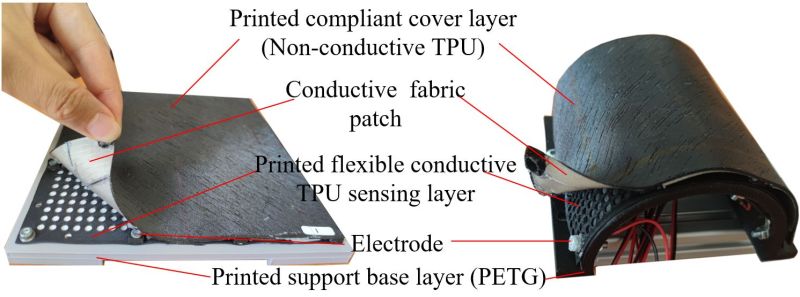
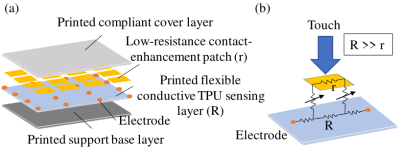
Schematic diagram of the touch-sensitive skin. (Credit: Haofeng Chen et al., ArXiv, 2026)

Hypoesthesia, more commonly referred to as numbness, is one of the more distressing ailments that can affect us humans, primarily because it reminds us of just how much we rely on our sensation of touch in daily life. From experiencing the world around us, handling objects, noticing when you just bumped into that side table again and the comforting hug of a fellow human being, touch is perhaps the most important of our senses.

In that regard the recently published research by [Haofeng Chen] et al. on giving robots a skin that can experience touch seems rather important as it would give especially humanoid robots a more natural way to interact with their environment, using feedback from touch.

Poking the artificial skin. (Credit: Chen et al., arXiv, 2026)

One of the essential parts of biological skin is that it is teeming with sensors, at a density level that provides excellent resolution as required, down to sensing e.g. small surface imperfections with one’s finger tips. Replicating this with an artificial skin for robotics has always been a problem, due to the wiring and/or reliability nightmare this poses with typical approaches. Instead of focusing on many individual sensors, [Chen] et al. focused on effectively creating the equivalent of a resistive touch screen in skin format.

The basic principle underlying the demonstrated artificial skin is electrical impedance tomography (EIT), which uses surface electrodes to form a tomographic image based on measures electrical resistivity. Core here is the flexible TPU layer with electrodes and the conductive fabric patches attached to the top TPU cover layer. The electrodes continuously measure the resistivity, with disturbances from those patches due to touch events on the cover layer altering these values. From this EIT can be used to reconstruct the location and strength of the touch event.

The results from the created prototypes were promising, with only 16 electrodes sufficing to create a fairly accurate pressure map. Hardware-wise this makes it thus quite uncomplicated, with the characterization of the TPU porosity and such along with the EIT algorithm (provided in the paper) probably being the biggest hurdles for hobbyist recreations.

Read the whole story
satadru
30 days ago
reply
I too have seen Star Trek: First Contact.
New York, NY
Share this story
Delete

Trade

4 Comments and 13 Shares
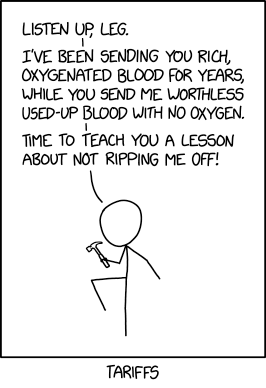
"You legs may have a comparative advantage at running, but we arms have a competitive advantage at swinging hammers, so unless you accept that we're the dominant limbs and stop hogging the oxygen, that running advantage won't be around for long."
Read the whole story
satadru
30 days ago
reply
Sigh...
New York, NY
acdha
29 days ago
reply
Washington, DC
Share this story
Delete
3 public comments
SimonHova
26 days ago
reply
Finally we are able to close the political cartoon deficit that has been open since Smoot-Hawley.
Greenlawn, NY
cjheinz
30 days ago
reply
More, please.
Lexington, KY; Naples, FL
alt_text_bot
31 days ago
reply
"You legs may have a comparative advantage at running, but we arms have a competitive advantage at swinging hammers, so unless you accept that we're the dominant limbs and stop hogging the oxygen, that running advantage won't be around for long."
Pylgrimm
30 days ago
"But you need us for getting around!" "Well, you need us MORE to swing a hammer." How many times in our life you think swinging a hammer is going to be more relevant than moving freely??" "There you have it, my fellow upperbodians, how uppity these lowerbodians can get after weak policies have allowed them to do whatever they want all these years! We tried to be nice and just do the right thing, but I see the only way forward is putting the fear of god in them and any other limbs or organs that refuse to admit our supremacy!" *replaces hammer with saw*

European Parliament Resolution Condemns Abduction, Forced Conversion and Child Marriage of Religious Minorities in Pakistan

1 Share

On July 9, the European Parliament adopted a Resolution (full text) on the abduction, forced conversion and child marriage of Hindu and Christian girls in Pakistan. It reads in part:

A.  whereas Maria Shahbaz, a Christian girl from Lahore, was 13 when she was abducted and forced to convert to Islam and marry her abductor;... whereas ... in March 2026 Pakistan’s Federal Constitutional Court upheld her conversion and marriage and ordered her to remain with her abductor;

B.  whereas there is a persistent and well-documented pattern in Pakistan of abduction, forced conversion and forced marriage of underage girls from Hindu, Christian and other religious minorities...

C.  whereas the Pakistani Government recently proposed a national framework to end child marriage aimed at strengthening the protection of minors; whereas legislation against child marriage raising the minimum age of marriage to 18 years was adopted in some provinces, which, however, lack enforcement;...

[The European Parliament] 1.  Strongly condemns the abduction, forced conversion to Islam, child marriage and ruling in the case of Maria Shahbaz, and similar abuses of underage girls from religious minorities in Pakistan;...

4.  Strongly condemns the systematic persecution of Christians in Pakistan and stresses that the abduction, forced conversion and child marriage of Maria Shahbaz must be seen in the wider context of discrimination, violence and intimidation faced by the country’s Christian community; demands that Pakistan repeal its blasphemy laws and end the persecution of Christians and other religious minorities....

7.  Encourages Pakistan to create a national mechanism for handling complaints from families of abducted or forcibly converted girls from minorities, and calls for comprehensive support for victims, ...; calls for addressing the root causes of forced marriage and conversion, including gender inequality, poverty, social exclusion and discrimination based on caste, gender and religion....

Faith and Freedom reports on the Resolution.

Read the whole story
satadru
49 days ago
reply
New York, NY
Share this story
Delete
Next Page of Stories