Hovertext: All of this is window dressing to justify panel 3.
Today's News:
Red Button mashing provided by SMBC RSS Plus. If you consume this comic through RSS, you may want to support Zach's Patreon for like a $1 or something at least especially since this is scraping the site deeper than provided.
Red Button mashing provided by SMBC RSS Plus. If you consume this comic through RSS, you may want to support Zach's Patreon for like a $1 or something at least especially since this is scraping the site deeper than provided.
Hovertext: The most valuable thing he owns are old Pokemon cards, so the Viking has to create an eBay account to complete the job of looting.
Today's News:
Red Button mashing provided by SMBC RSS Plus. If you consume this comic through RSS, you may want to support Zach's Patreon for like a $1 or something at least especially since this is scraping the site deeper than provided.
Benjamin Schneider has an interestingly wrong proposal for how to extend the Interborough Express, currently designed to run between Southern Brooklyn and Jackson Heights, toward LaGuardia Airport. I know he cares a lot about urbanist issues and public transportation, so I’d like to explain what’s in this proposal, how it errs, and how it is similar to other problematic proposals, for example by the Regional Plan Association in the Third and Fourth Regional Plans in how it tries to make one centerpiece do too many things. We considered a similar plan for inclusion in A Better Billion and chose not to, and instead connect to the airport via the Manhattan-facing Astoria Line carrying the N and W trains.
What’s the proposal?
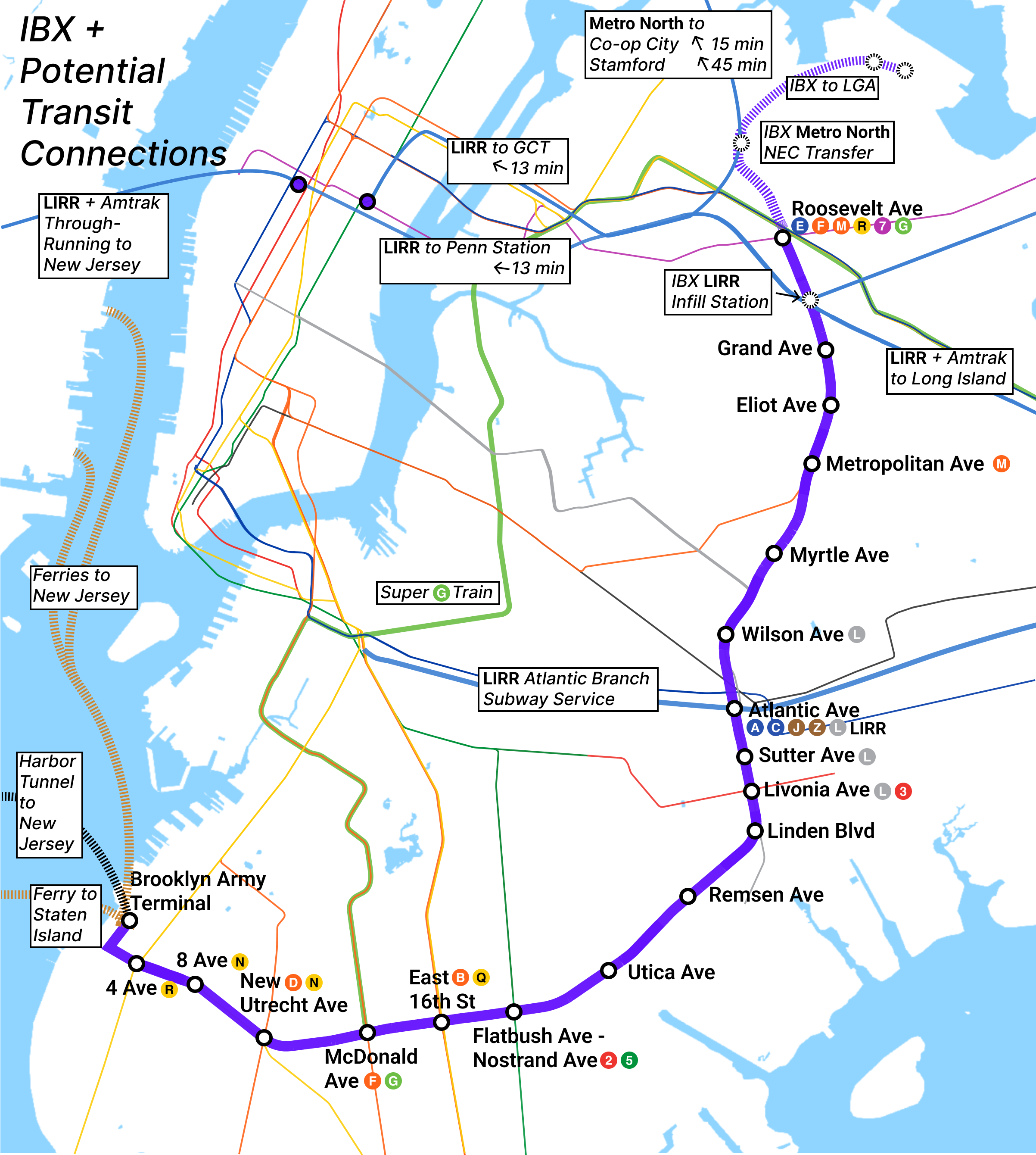
The idea is to extend IBX to the airport, in the following way:
The plan adds an infill station for a transfer to the LIRR and extends the line in a slightly roundabout way to connect to an infill Northeast Corridor station before veering to the airport. This distinguishes it from early ideas that didn’t make it to A Better Billion, namely a Y from IBX to both the airport and Harlem. The point of this is not just to connect IBX with the airport but also create a hub by connecting IBX to more things, in this case a transfer station designed to connect people from the entirety of the New Haven Line to LaGuardia.
Why doesn’t this work?
The general answer is that subway lines should be radial or circumferential and not mixed, and this is a mix – IBX is circumferential, connecting stations at a fairly consistent distance from Manhattan, and the extension to the Northeast Corridor (or even Harlem, well north of Midtown) would maintain this character, but a tail veering to the airport would suddenly be radial. Such lines always underperform, because they fail at both the function of a radial line, namely connecting outlying areas to city center, and those of a circumferential, namely connecting lines to one another better and providing near-center neighborhoods with additional service orthogonal to the radial direction.
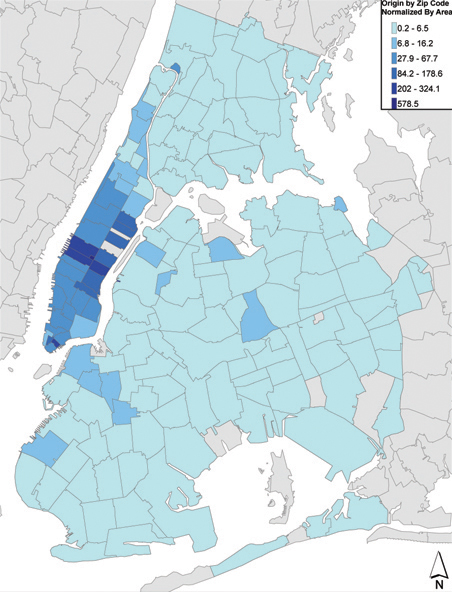
The more specific answer is that we know where passenger demand to LaGuardia is, and it’s nowhere on IBX or for that matter on the New Haven Line. Airport passenger demand is extremely Manhattan-centric, and within Manhattan it centers on Midtown and the Upper East Side:
At the proposed IBX-NEC transfer point, just about every passenger from the airport would transfer to the commuter trains. The required infrastructure to build this might as well be used on a commuter rail branch, going to East Side Access as it is more central for air travelers than Penn Station based on the above map. IBX is more or less useless. Or, better yet, the Astoria Line can be extended as we propose, along an easier alignment that can be done largely above ground.
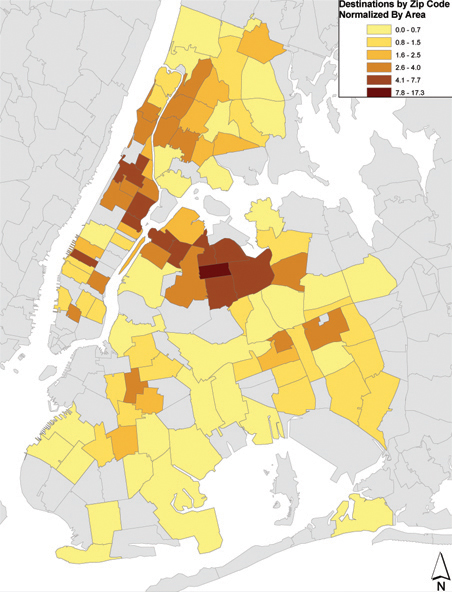
Now, what about airport workers? Those are usually mentioned, almost always as an afterthought, in various justifications for lines; I heard transit advocates use that line to argue for Andrew Cuomo’s backward air train idea back when he was still governor. Those are still poorly served by an IBX extension. On a map of airport employee residential density, it looks almost good:
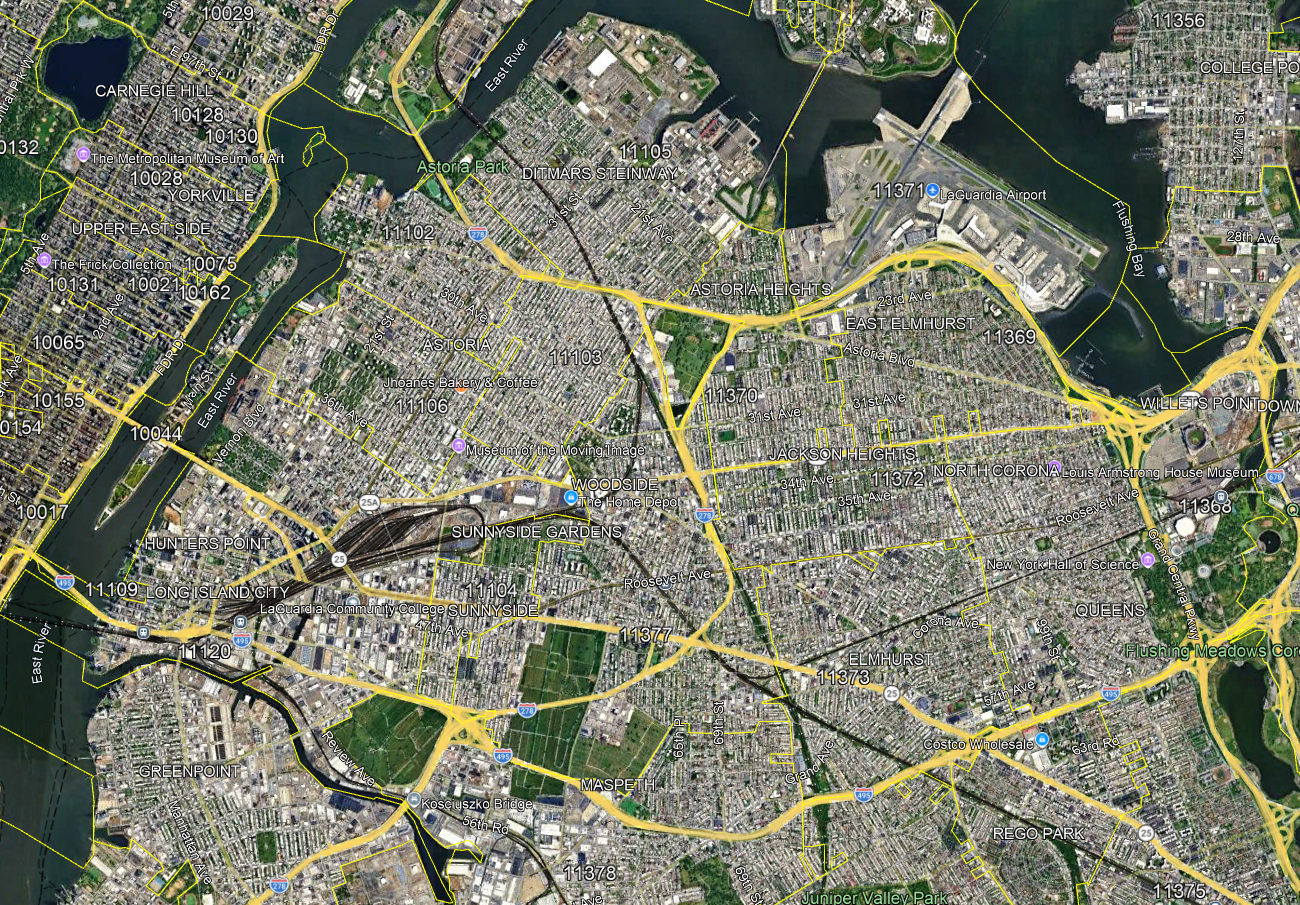
The highest-density zip code on the map above is 11372, whose southwest corner is Jackson Heights. But what’s unclear from the picture above is just how circuitous a swing from Jackson Heights to almost Astoria to LaGuardia is. The straight line distance from Jackson Heights to the nearest potential transfer station location to Terminal B is almost twice that of the direct straight line distance from Jackson Heights to Terminal B. The street grid isn’t straight but neither would an IBX extension be, needing to keep going northwest before turning 120 degrees to the east to get to the terminals. For most people in these neighborhoods, IBX would not provide a trip time improvement over buses.
But more conceptually than this, rail improvements aiming to serve airport workers are generally a bad idea, because airport workers never cluster in one residential place on which a line can be built. The paired density maps are at different scales, and the ratio between the densest and least dense colors is much higher for the air traveler density map than for the airport employee one. OnTheMap gives, as of 2023, 11,000-12,000 airport workers, depending on whether one counts hotel workers across the Grand Central Parkway from the airport in the total. Out of 11,666 on a more generous count, only 3,200 even live in Queens and only 1,182 live in Brooklyn. The blob of seven high-density zip codes of worker origin plus the medium-density one between them (11377, just west of Jackson Heights) only furnishes 1,000 airport workers from all eight zip codes combined.
How does this relate to previous proposals?
There’s a tendency in New York planning, at all levels of officialness from the RPA down, to take one big project that’s politically agreed on and hang everything on it. The Third Regional Plan tried to tie in everything to Second Avenue Subway, to the point of bloating it to a four-track line (by the 1990s all planning was for a two-track line). Even commuter rail, in this case a LIRR Atlantic Branch connection to Lower Manhattan, was shoehorned into it, with through-service onto the subway. The Fourth Plan did the same with its Triboro proposal running through to Metro-North in the Bronx and with commuter rail through-tunnels trying to work around Gateway.
The result of such schemes is proposals that try to have a single line do work it cannot possibly do and would be compromised to the point of unusability if it were forced. In Los Angeles, for example, this is leading to a squiggle of a subway extension of the K (Crenshaw light rail) Line through West Hollywood, 6 km longer than it needs to be. In New York, this is leading to taking IBX, as pure a circumferential as one can be, and lading it with tunnels to destinations for which it doesn’t make sense.
It’s important to resist this temptation. If rail service to LaGuardia is desired, it should use the subway line that already points in that direction, whose alignment allows for an elevated extension, just marginal enough to the residential parts of Astoria to avoid NIMBYs, just close enough to still serve the neighborhood well. The overall planning complexity of two good lines is less than that of one bad line – the cost doesn’t magically increase just because the rail link from Astoria to LaGuardia is categorized as “N/W extension” rather than “IBX extension,” and it’s easier to supervise more, smaller projects if they’re parallelizable.
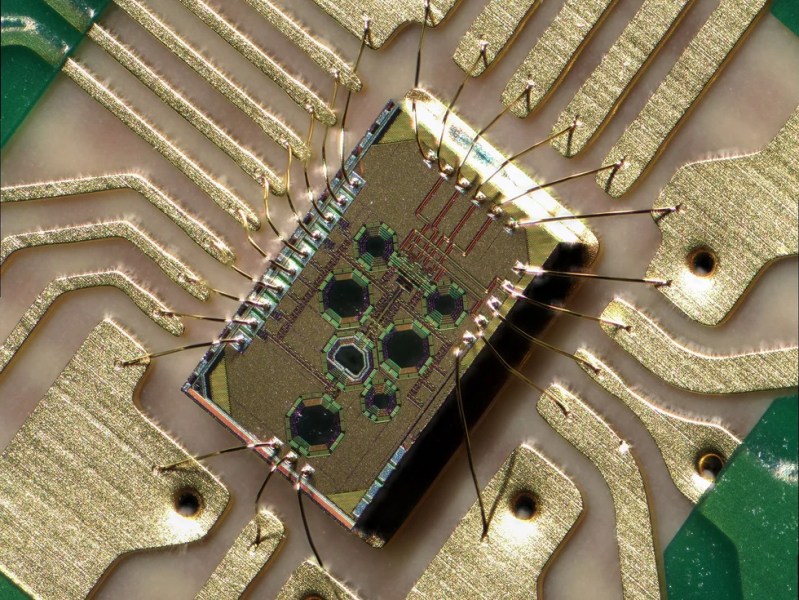
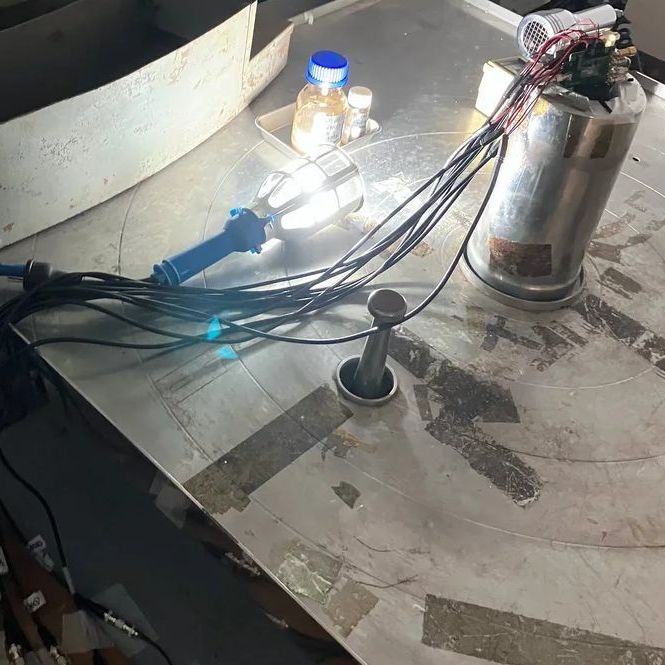
Exposing the Wi-Fi chip to gamma radiation. (Credit: Yasuto Narukiyo et al, 2026)
From outer space to down here on Earth, there are many places where ionizing radiation levels are high enough that they effectively bar access for humans, but also make life miserable for anything containing semiconductor technology. This is especially true for anything involving wireless communications, such as Wi-Fi. However, recently Japanese researchers have created a Wi-Fi chip that is claimed to be so radiation-hardened that it can be used even in gamma ray-rich environments, such as in the worst contaminated depths of the Fukushima Daiichi nuclear reactor.
The indicated dose exposure of 500 kilograys that the chip survived during testing is quite significant. A single gray (Gy) is the absorption of one joule of energy per kilogram of matter. In radiation therapy, a solid epithelial tumor can receive as much as 60 to 80 Gy in a single dose, for example.
That this Wi-Fi chip was still able to function after such a large cumulative dose was therefore quite impressive, as it rivals what space-based probes receive over numerous years. Unfortunately, the research paper is paywalled, but the PR article from the Tokyo Institute of Science fills in a few more details along with the IEEE Spectrum article.
The key was reducing the number of transistors to offer as few targets for radiation as possible. Further inductors were used instead of transistors, for example, variable-gain, as these are less sensitive to ionizing radiation. Remaining transistors were physically enlarged, reducing the number of parallel segments and using NMOS transistors instead of PMOS, due to the latter’s higher radiation resistance.
Although degradation in receiver performance was observed after successive blasts at 300 kGy and then 500 kGy, the change was on the order of 1.5-1.6 dB. The next challenge is to make a Wi-Fi transmitter, which is much harder and may require the addition of materials like diamond.
Nice. Worth noting that there are recent kernel commits for regular mediatek wifi hardware that note adjustments for radiation exposure. POTS hardware is also expected to continue working in radiation exposure environments like space and handle bit flips from radiation exposure!
 Log in