E-ink displays have a number of advantages over other display types, but their refresh rate isn’t one of them. But what exactly makes them slow? According to [Wenting Zhang], it’s not an inherent limitation of the technology. It’s mainly the controller, and this limitation can be overcome to create a high-resolution 60 Hz refresh rate E-ink display, totally suitable for use as a computer monitor.
The reason E-ink displays are so slow is simple. For a long time, they existed for only one purpose: to be screens for e-readers. They had to work on devices that were generally low power, with limited interfaces and slow processors. Accommodating these factors was the primary driver behind the high latency and slow refresh rates associated with these displays.
It was actually the limited interface options rather than the slow refresh that initially led to a custom controller, because [Wenting] wanted to use an E-ink display on a laptop build. But it quickly became apparent that a custom controller could do considerably more than E-ink was known for.
Initial tests with fast refresh rates were so positive that it led to a Hackaday Supercon 2024 talk on how to make E-ink go fast, and more recently has culminated in the Modos Flow, a fully open-source, user-repairable 13.3″ portable E-ink monitor.
The development path from proof of concept to finished product has been a long one for [Wenting]. Not only did a lot of optimization and feature work need to be crafted from scratch in order to effectively balance appearance with responsiveness in different display modes, but the usual hassles of development and bad timing were also in full force. On top of it were wasteful vendor shenanigans, as well.
Check out the story in the video, embedded just below. If you’d like to buy one, there are monochrome and color versions offered through Crowd Supply.
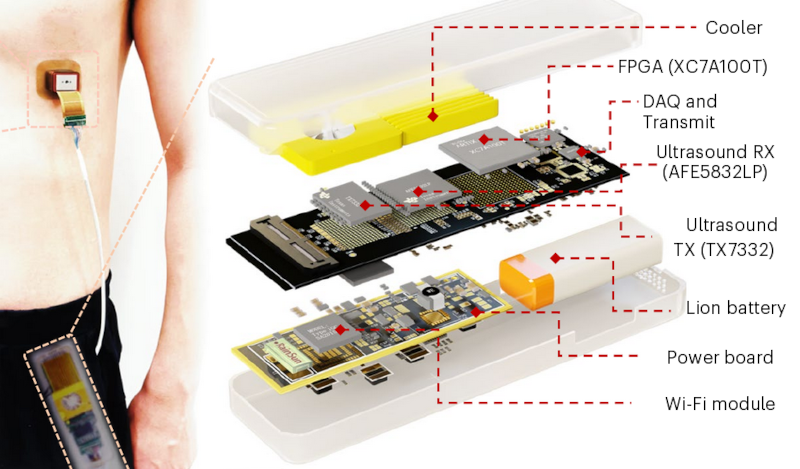
A pacemaker is implanted to send signals that regulate a patient’s heartbeat, and to do that, you need power. That means they require battery changes, and when the device in question happens to be inside your chest, that means surgery. Sometimes as often as every five years. [Alex Music] writing in Spectrum notes that researchers have a new paper discussing a possible alternative: a tiny patch stuck to the outside of the chest that uses ultrasound to pace the heart rhythm.
Rats, pigs, and human heart cell samples have all responded to the system. You might wonder how ultrasound could make your heart beat, but the new pacemaker relies on gene therapy to sensitize your heart cells to the high-frequency waves. The therapy is delivered by a simple injection.
In addition to the chest patch, the patient would need a data and power module that they could keep in their pocket. The gene therapy doesn’t alter your DNA but introduces RNA to make heart cells produce a sound-sensitive protein in the cell’s ion channels. When stimulated, the ion channels admit calcium, which causes the heart to beat.
Pacemakers are nothing less than a modern technological marvel. Maybe if this catches on, cheap junked pacemakers will show up on the surplus market. They could be useful.
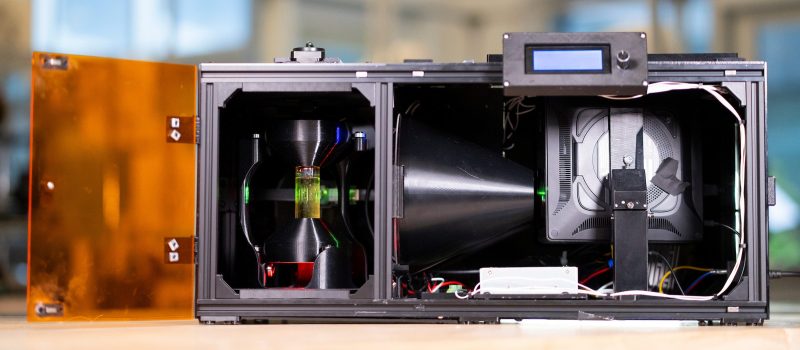
Computed Axial Lithographic printing gets even closer to the Star Trek replicator fantasy than any other 3D printer we’ve seen: there’s a machine, it glows with a mysterious bluish light, and an object appears. OK, the object is appearing inside a spinning vat of photochemical ooze, not in thin air, but that’s a detail. It’s still very cool tech, and now it’s open source enough to replicate with full documentation and a GitHub repository.
This project is descended from the same Berkeley research that we featured last year, but at that point, they were inviting everyone to join their Discord server, and that was about it. At the time, we put on our old man outfit to yell at clouds and say, “A Discord shouldn’t count as open source!” For once, it looks like those geriatric grumblings were heeded. There is still a corporate-hosted chat server named for a malignant goddess, and you’re still invited, but now there’s also actual, searchable documentation!
As with all CAL, there’s still the spinning vat of specially viscous photopolymer resin, and the light is provided by a NexiGo Nova Mini projector. There’s no FEP to worry about, and no stops and starts: the vat spins, the projector exposes the resin, and a part appears almost faster than can be believed, with spatial resolution like an older SLA
The instructions for putting that projector-based printer together look good; there are even instructions for mixing the special resin, though pay attention to the safety warnings in the “Don’t Try This At Home” banner. Apparently, they’re going to have FormLabs mix resin for those who cannot do it themselves, which seems like a valuable partnership for people who want to limit exposure to toxic ooze. Of course, that’s what a fume hood is for.
An infuriating story about something most of us don’t really stop to think about: e-books and the rendering engines companies and software use to display them.
It’s the year 2026. Thanks to the horrendous [Adobe] RMSDK which Kobo decided to use as their backbone for all book rendering (probably for DRM reasons), a single line of perfectly valid CSS turns a perfectly valid EPUB file into a “corrupted file” on Kobo and just drops the whole book. No clear error message, no fallback. Just a massive fail.
The level of obnoxiousness goes even deeper: Kobo devices ship with a better, actually maintained renderer for e-books as well, but in order to have a book use it, the book file in question needs to have a specific file extension. Remember that e-book files are just packaged websites; there’s no reason to do any of this nonsense with two rendering engines, one of which is shit and frozen in time.
I have never had to do anything related to creating an e-book – I just put books on my own Kobo and read them – and even I am getting annoyed just reading this.
“Space computing, the final frontier, has arrived,” Nvidia CEO Jensen Huang declared at the Nvidia GTC conference in March.
Indeed, the idea of data centers in orbit has gone from science fiction to a serious spending category. Elon Musk’s SpaceX has acquiredxAI (also Musk’s) and is planning a constellation of space-based data centers. Google, not to be outdone, announced Project Suncatcher in partnership with Planet, planning to launch two satellites equipped with Google Tensor Processing Unit (TPU) AI chips by early 2027. Startup Starcloud has already filed a proposal with the Federal Communications Commission for an 88,000-satellite constellation for orbital data centers. As Starcloud’s filing suggests, these companies are all proposing fleets of satellites numbering in the thousands, each housing a rack or multiple racks of AI-grade GPUs, interconnected with each other through free-space optical links and communicating back to Earth via microwave links, either directly or through other satellites.
Proponents tout the many wonders of computing in space: abundant solar energy, free cooling, and freedom from Earth-based disturbances like earthquakes, floods, and protesters. But a sober look at the physics of space-based computing paints a much more nuanced picture.
Free cooling is perhaps the biggest misconception. Space is cold, but it also has no atmosphere. That means the best heat-removal mechanisms, conduction and convection, are off the table. The only option is radiation. To prevent a chip from overheating in space, a large, costly surface area is required to dissipate the energy and then radiate it.
Solar energy is abundant, but collecting it with functional solar panels that maintain perfect alignment toward the sun is a complex task requiring extensive attitude control systems. On top of that, ionizing radiation in space from cosmic rays and other sources poses a unique challenge, degrading the solar panels, the radiative coolers, and the chips themselves. Because regular maintenance in space is difficult, redundancy has to be built in at launch, and cost estimates have to account for efficiency degradation over time.
At ABI Research, where I work as an aerospace analyst, we did a rough total-cost-of-ownership comparison between a data center on Earth and one in space. It showed that the cost to launch and run a GPU in space for a year is at least an order of magnitude higher than the same feat in a terrestrial data center. Our model was simple, assuming an Nvidia H100 server rack launched with the requisite-size solar panel and radiator on a spacecraft akin to Starcloud’s pilot launch. We assumed SpaceX’s Starship was used at a highly optimistic launch cost per kilogram of US $44, and a terrestrial energy cost of $0.20 per kilowatt hour. This is a simple back-of-the-envelope calculation, but it does signal something real.
From our perspective, the cost of delivery and space hardening of the payload makes general-purpose space-based data centers difficult to justify economically today, despite the fact that data-center builders in many regions are scrambling for electric power. However, there are niche applications where the much higher costs of computing in space could be justified. Examples include preprocessing data from Earth-observation satellites, real-time detection and tracking of hypersonic missiles, and active collision avoidance in the increasingly crowded low Earth orbit. Even for these, though, contending with fundamental physics will still be a demanding challenge. And a technologically compelling one, too.
The Cooling Challenge in Space
Cooling is where physics separates the science from the fiction. The governing equation for radiative cooling, the only type of cooling available in space, is known as the Stefan-Boltzmann Law. It states that the amount of power you can radiate is proportional to the area of the radiator times its temperature to the fourth power. For a space systems architect, the implications of this law are brutal. In orbit, the only variable we can control is area. This restriction creates a geometric penalty, or a “physics tax,” for cooling in space: The more power you need to reject, the bigger the area of the radiator you need to bring along from Earth.
The only cooling method available in space is radiation, and the radiator area required is derived using the Stephan-Boltzmann law. For a single chip drawing 700 watts, like Nvidia’s popular H100 GPU, the area required to keep it at 20 °C is just under 3 square meters, and it goes down to 1 square meter for an operating temperature of 85 °C. However, as the radiator surface is exposed to ionizing radiation, its emissivity decreases, and after 5 years in space the required area increases by about 40 percent.
To understand how big this baseline area is in practice, I used the Stefan-Boltzmann law to model the heat-rejection area needed to keep a single chip that draws 700 watts of power—such as the H100 GPU chip, an AI stalwart—at a constant 60 °C, usually considered the sweet spot for GPU longevity and stability. I further assumed that the radiator is perfectly facing deep space, at a chilly background temperature of 3 kelvins. By this calculation, a single chip would require 1.4 square meters of radiator surface.
To put this into perspective, consider that a common AI rack can hold approximately 32 GPUs (four H100 server boards). With CPUs, memory, and networking equipment, this rack would draw around 40 kilowatts of power. This single rack includes 2.5 terabytes of memory—enough capacity to serve over 20,000 concurrent users or run 16 simultaneous instances of Llama 3, an open-source AI model. But to cool this thermal load in a vacuum, that single rack would require an 80-square-meter radiator, roughly the size of a pickleball court. For an aggregate 100-megawatt data center, you’d need at least 2,500 of those radiators.
And that’s the best-case scenario. Additional problems are hidden in the low Earth orbit environment itself. Space exposes radiators and their coatings to a chemically hostile brew of ultraviolet light and atomic oxygen, quite the opposite of a clean-room environment. Over a LEO satellite’s typical 5-year lifespan, these elements degrade the radiator’s surface properties and lower its ability to shed heat.
Including this degradation in the model reveals that as the radiator degrades from a “fresh” state to an “end-of-life” state, the physics demands a further penalty. To maintain that same 60 °C operating temperature for the GPU chips, the required surface area jumps from about 1.4 square meters per chip to nearly 2.0 square meters. In other words, the physics tax rises by 40 percent. Therefore, you must launch at least 40 percent more radiator mass, endure higher atmospheric drag, and sacrifice valuable launch volume just to survive the degradation of the thermal coating. This increase adds significantly to the launch cost and further erodes the economics of a space-based data center.
The Silicon Challenge in Space
Solving the heat problem is only part of the battle. The other significant challenge in low Earth orbit is ionizing radiation, which affects the computing hardware itself. Today’s satellites typically use radiation-hardened processors, which are very reliable but also much more expensive, and they perform poorly compared to commercial off-the-shelf processors.
A standard rad-hard chip doesn’t have the processing power to run a modern large language model (LLM). As a result, satellite operators aspiring to launch a data center have no choice but to make a risky compromise: to use hardware meant for terrestrial use. In order to achieve the necessary compute density, orbital data centers must use the same Nvidia H100s or Google TPUs found in terrestrial server farms. The problem is that these chips are “soft” targets in space. High-energy particles can flip bits in memory or cause “latch-ups” in logic that fry the circuit.
One possible option is to shield the computers from radiation with thick, absorbent panels. However, the shielding would add significantly to the already heavy satellites. The other option is to compensate for the radiation damage with redundancy. Indeed, edge computing architects are moving toward software-defined resilience, where instead of one perfectly hardened computer, operators fly a cluster of imperfect, commercial ones whose total cost could be as low as one-tenth to one-hundredth that of the rad-hard model.
This redundant approach is used in many spacecraft, including Artemis II, which recently carried astronauts around the moon, as well as SpaceX’s flight computers and the Hewlett Packard Enterprise edge servers for the International Space Station. By running three (or more) instances of the same calculation on three different nodes and comparing the answers, the system can detect a corrupted processor. If a node fails, the “orchestrator” reboots it while the others continue the mission. While this ensures resiliency, it also means that some fraction of the compute capacity is dedicated to redundancy, further increasing the costs.
The Energy Challenge in Space
An often-touted advantage of space-based data centers is the seemingly unlimited supply of free, clean energy from the sun. Solar energy in orbit is indeed abundant, at 1,361 watts per square meter. Of course, capturing that free energy is made possible only by the very costly launching of large solar panels into orbit. And those solar panels also degrade over time due to radiation exposure, typically losing 1 to 3 percent efficiency per year.
Let’s say a solar array collects 1 MW of power to run an AI cluster. The laws of physics demand that the satellite must eventually radiate 1 MW of waste heat. Because the square area needed to generate the solar power—around 400 W/m2—and to reject the heat—around 450 W/m2—are nearly equivalent, every square meter of power generation now demands approximately another square meter of cooling. The radiator needs to be a structural equal, not merely a passive coating on a surface used for something else.
As Elon Musk recently noted in Davos, the most efficient radiator is one that never sees the sun. By orienting the spacecraft so the solar panels face the sun and the radiators face the deep vacuum of space, efficiency skyrockets for both. But there’s a catch: Maintaining this perfect three-way alignment—panels to sun, radiator to the void, antennas to Earth—requires complex, high-torque attitude control systems. So this configuration means more payload and more computing power. Plus, these control systems are complex components with many failure modes, which is not optimal in a situation where maintenance is difficult.
The Killer Apps for Computing in Space
Given all these challenges of deploying massive radiators for satellites in the hostile environment of space, why build data centers in space at all?
While training or inference on LLMs in space doesn’t seem economical today, there are other, very compelling applications for computing in space. Here are two: solving the downlink bottleneck from Earth-observation satellites and enabling collision-preventing maneuvers in the increasingly crowded low Earth orbit.
The latest Earth-observation satellites, equipped with hyperspectral and synthetic aperture radar sensors, are used for a range of important reconnaissance missions, such as battlefield intelligence, tracking the global shadow fleet of ships carrying contraband, and assessing earthquakes or infrastructure failures down to the millimeter. These systems can generate hundreds of terabytes of raw data per day that must be transmitted to Earth. However, the radio-frequency “pipes” used to downlink the data are congested, and the ground infrastructure cannot absorb the sheer volume of raw data.
Another immediate, mission-critical application for in-space computation is protecting the orbital environment. With over 17,000 satellites in orbit, the overwhelming majority of which are in low Earth orbit, avoiding collisions between these satellites is crucial. As NASA astrophysicist Donald Kessler pointed out back in 1978, a single space collision could cause a cascading effect that renders the entirety of LEO unusable.
According to SpaceX’s recent annual report, the Starlink constellation executes a collision avoidance maneuver every 2 minutes on average. Each maneuver already relies on onboard AI systems but still requires most of the processing to happen on the ground.
As low Earth orbit gets increasingly populated, collision avoidance will have to break the traditional ground-loop model. In the megaconstellation era of space, the OODA (observe, orient, decide, act) loop must happen onboard, thereby reducing the analysis turnaround from minutes to milliseconds.
The problem is that the flight computers standard on satellites are not built for this level of processing. The complex probability models required for maneuvering cannot currently be implemented by onboard computers in conjunction with their navigation systems. Clearly, more powerful computers are needed.
This is the true economic justification for moving compute to space: to move insight generation there. By placing high-performance computing adjacent to the sensors, we can process terabytes of data in orbit and downlink only the relevant data in real time, and we can do the computations necessary to avoid satellite collisions in real time.
The Future of Computing in Space
So, assuming that some form of computing is inevitable in low Earth orbit in the foreseeable future, how will the heat be handled? The industry is currently experimenting with two main classes of solutions to cope with the Stefan-Boltzmann law.
One creative option is to use origami-inspired radiators, the kind used for the James Webb telescope. Companies are developing flexible, high-conductivity composite radiators that fold into a tight cube for launch and unfurl into enormous yet lightweight thermal wings in orbit.
Another possibility is to use liquid-droplet radiators. This concept proposes removing the rigid radiator structure completely and instead spraying a stream of coolant oil directly into the vacuum of space. The fluid travels through an open loop, exposed to the near-absolute zero of the void, maximizing radiative surface area before being caught by a collector and pumped back into the ship. It sounds like science fiction, but as the heat loads climb into the megawatts, liquid-droplet cooling may be the only way to cheat the mass limits of this exponential reality.
Options for Future Radiator Design
Our rough total-cost-of-ownership model uses optimistic versions of current numbers, such as launch cost, chip cost, and power use. A critic might point out that future technology will improve, both in efficiency, purpose-built designs, and costs.
Sure, the technology is bound to improve. But the critical factor isn’t just launch cost; it’s the computing power per unit mass and electric-power economics. Radiators and solar arrays can consume 65 to 70 percent of total satellite mass, and space-grade photovoltaics run orders of magnitude more expensive than terrestrial equivalents.
Chris Philpot
Even as launch costs fall, the mass and cost burden of power generation and thermal management will remain a fundamental problem.
Current space-grade solar panels rely on germanium substrates, whose supply is concentrated in China. It will be extremely difficult to scale up availability of these substrates. A transition to radiation-tolerant perovskite solar panels or a similar alternative could change the economics significantly, but that possibility is five years away or more. The technology will get cheaper, but the bottlenecks of power and thermal architecture will remain.
Recognizing the thermal reality of cooling in space forces us to shift how we view satellite operations. We are moving away from the “launch and forget” era toward an era of “autonomous logistics.” As our thermal model demonstrated, the harsh environment of space steadily attacks the hardware. UV radiation degrades thermal coatings; cosmic rays degrade silicon. In a traditional satellite model, when the radiator degrades or the memory fails, the satellite becomes space junk. For a multimillion-dollar data center, that disposal model is potentially ruinous.
To make the economics of orbital computation work, the infrastructure must be serviceable and the rockets to launch them reusable. The orbital domain will require automated servicing vehicles capable of swapping out degraded radiator panels and upgrading fried servers. In these ways, the future of the orbital data centers is dependent on the innovations of an emergent in-space economy.
There’s a good argument to be made that the need for space-based computation is less of a hype cycle and more of an enabler for the new space economy. Look no further than SpaceX’s recent regulatory filings proposing a constellation of up to a million satellites in low Earth orbit. At such a scale, routing all raw data back to Earth is physically impossible; the network itself must become the data center.
However, the winners in this sector will be determined by the systems architects who most cleverly accommodate the thermodynamics and the companies with sufficient vertical integration to take on the massive costs of operating data centers in orbit. Ultimately, the physics tax is universal. Whether managing heat rejection in the vacuum of low Earth orbit or managing power density in a hyperscale facility in Northern Virginia, the constraint is never the silicon. It’s the thermodynamics.
A man raises his phone as police move into a crowd. The video is shaky, loud, immediate. Within minutes, it is online. Within hours, it is everywhere. This is how accountability works now. Something happens, someone records it, and that footage can show what really happened, sometimes contradicting official accounts. It can empower citizens and create consequences for officials.
An ouroboros is an ancient Egyptian symbol, a snake or dragon eating its own tail. As I began to see patterns in my broader research on surveillance corporatism and governance lag, I began using the term “surveillance ouroboros” to describe this recursive pattern of observations intended to hold power accountable becoming new input for the same surveillance infrastructure.
Facial recognition changes accountability
During the George Floyd protests in 2020, people filmed police in real time. Phones were pointed at officers, not at each other. The goal was simple: to show what the state was doing. That footage spread quickly and became part of a much larger pool of public data.
At the same time, reporting from outlets including The New York Times and BuzzFeed News showed that law enforcement agencies were using facial recognition tools, including systems built by Clearview AI. Those systems were built from billions of images scraped from across the internet, including publicly available photos and videos.
The basic approach is now routine: People record the state, or anything else—as in the January 6 attack on the U.S. Capitol—and the state compiles that footage and data into a searchable environment, which may later be used to identify some of the same people who made the footage.
Facial-recognition systems used by law enforcement are increasingly outpacing the legal safeguards.
A 2024 Government Accountability Office review found that federal law enforcement agencies continued to expand their use of facial-recognition systems for criminal investigations despite ongoing concerns around training, privacy protections, civil-liberties safeguards, and oversight. Earlier GAO findings showed that agencies had conducted roughly 60,000 facial-recognition searches before formal training requirements were put in place for personnel using the systems.
The American Civil Liberties Union and other groups have warned that these tools could be used to identify people from images shared online, including protest-related footage. Concerns about facial recognition led some U.S. states and cities, including San Francisco and Boston, to restrict or ban government use of the technology, while federal agencies have continued to face scrutiny over how such systems are tested, deployed, and audited. A 2024 analysis published in Internet Policy Review warned that facial-recognition systems used by law enforcement are increasingly outpacing the legal safeguards meant to govern them, creating growing tensions around data protection, oversight, and proportional use.
The spy network that built itself
Surveillance used to require infrastructure. Cameras had to be installed and data had to be collected deliberately. That is no longer the case. People carry cameras everywhere. They record constantly and upload in real time. Events are documented from multiple angles without planning or coordination. The cumulative result is a continuous stream of usable data: faces, locations, timestamps, and interactions. The Internet of Things also waits all around us, gathering information and releasing it when people least expect it, as Andrew Guthrie Ferguson describes in a recent excerpt of his book Your Data Will Be Used Against You.
Similar dynamics are emerging globally. A recent analysis in the International Journal of Law and Information Technology examined how facial-recognition systems in China and Japan are expanding faster than the legal frameworks governing them. Reporting by The Guardian described the limited legal protections around the rapid deployment of AI-assisted surveillance infrastructure across parts of Africa.
There used to be a clear distinction between surveillance and accountability. Surveillance meant the powerful watching the people; authorities tended not to share their imagery except under duress or a court order and usually after a long delay. Accountability meant the people watching the powerful, and often publishing imagery immediately to head off or counteract official mischief. That distinction no longer holds. The same footage can serve both roles. A recording meant to expose misconduct can later be used to identify someone else entirely.
Surveillance ouroboros is not a future risk. It is already here.
This dynamic persists because people still need to record. In many places, it is one of the only tools available when formal accountability breaks down. When oversight institutions weaken or fail, public documentation becomes a substitute. In that environment, people turn to visibility. But that visibility comes with a cost. The more people that document, the more data that exists. The more data that exists, the easier it is to search, match, and store. Every video feeds the ouroboros. People are not feeding the system because they trust it. They are feeding it because the alternative is silence.
Most of the people in these videos are not the focus. They are in the background, passing by or standing nearby. But that distinction does not matter once the footage enters a system. Today’s facial recognition can identify even a face that passed through the corner of a frame. Someone who did nothing can still become part of a dataset without ever knowing it. As recognition systems improve, older footage becomes more useful, and invasive.
No single decision created this outcome. It emerged gradually through more cameras, better recognition, larger datasets, and easier integration. Each step made sense on its own. Together, they changed what recording means.
Public recording is still necessary. Without it, many forms of abuse would remain hidden. But recording is no longer just exposure. It is also contribution. If you published imagery or video last year, you may already have contributed to a system you have never seen, but the ouroboros has.
Surveillance ouroboros is not a future risk. It is already here. Every time someone presses publish, they are doing two things at once. They are exposing power, and they are helping build the system that the powerful will later use to track the less powerful.
 Log in



 The reason E-ink displays are so slow is simple. For a long time, they existed for only one purpose: to be screens for e-readers. They had to work on devices that were generally low power, with limited interfaces and slow processors. Accommodating these factors was the primary driver behind the high latency and slow refresh rates associated with these displays.


 Chris Philpot
