Biomedical Engineering, Medicine, Public Health, Open Source, Structural Solutions
16054 stories
·
227 followers

Researchers Publish Method to Surveil Web Page Visitors by Analyzing Their SSD Activity

1 Share

Dan Goodin, reporting for Ars Technica:

The technique, laid out in a research paper, exploits a side channel, a form of leak resulting from physical manifestations such as electromagnetic emanations, data caches, or the time required to complete a task. By measuring the manifestations, attackers can decrypt encrypted traffic and infer other confidential data. [...]

“Web browsers have evolved from simple document viewers into complex platforms capable of running sophisticated applications,” the paper authors wrote. “Companies like Google, Microsoft, and Adobe have developed full-fledged office suites, photo- and video editors, or even integrated development environments (IDEs) that run entirely within the browser.” The authors went on to note: “While these features enhance the capabilities of web applications and allow completely novel use cases, they also increase the browser’s attack surface, and some have already been shown to introduce new vulnerabilities.”

Unlike previous contention side-channel attacks on SSDs, FROST runs exclusively in the browser. It uses JavaScript that interacts with the OPFS (origin private file system), an allocated storage space that’s reserved for a specific site to run code needed to complete a given task. Websites can create one with no interaction required by the visitor.

JavaScript, as I have suggested many times, was a terrible mistake for the web. It’s absurd that a web page can access local storage space.

Link: arstechnica.com/security/2026/05/websites-have-a-new-way-to…

Read the whole story
satadru
44 minutes ago
reply
New York, NY
Share this story
Delete

A Modern Web Browser For Classic Mac OS

1 Comment

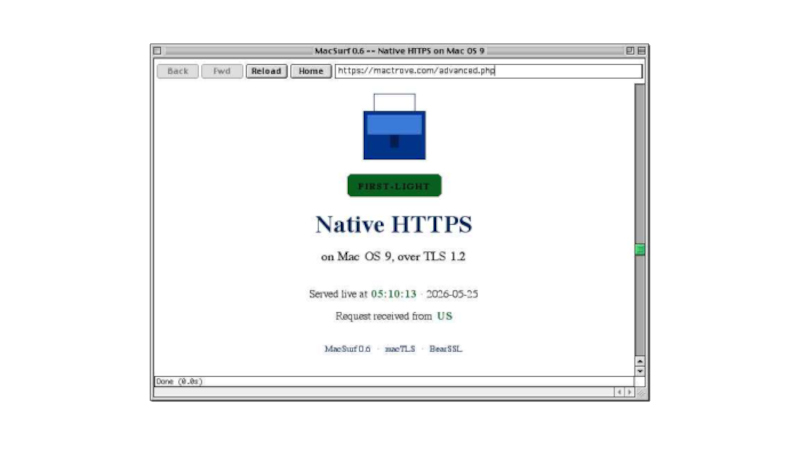
When using older computers there comes a point at which modern software drops support, as for example is happening with builds for Windows XP. Every now and then though, along comes something that bucks the trend. Enter [mplsllc] with Macsurf, a port of the Netsurf browser for classic MacOS 9 on PowerPC. Bring your nineties beige box back online!

The first generation of PowerPC Macs occupy an odd position, being faster and more capable than their predecessors while not sharing the ability to run MacOS X like their G3 descendants. Macsurf has the promise of bringing them into the 2020s, but if you’re expecting the equivalent of Google Chrome you might be disappointed.

Netsurf is a browser that started life on RiscOS, the original ARM OS from the Acorn Archimedes. It’s lightweight and portable, it’s an active project, it has a good rendering engine that does up to date HTML and CSS, it offers native TLS, and it has JavaScript built in. It’s ideal for a 1990s PowerPC, but with the caveat that sites expecting the very latest browsers might struggle. Sadly we don’t have a ’90s Mac to hand so we can’t try this port, but we’re used to it on other lower-power machines so we thing it’ll be a great asset to the platform.

We last looked at Netsurf when we had a look at RiscOS, if you are interested.

Read the whole story
satadru
52 minutes ago
reply
Finally a competitor to iCab I joke!

🧓
New York, NY
Share this story
Delete

Remember when people said open video codecs would never win?

1 Comment

The Alliance for Open Media has published the first version of the AV2 specification.

AV2 is the next-generation video coding specification from the Alliance for Open Media (AOMedia). Building on the foundation of AV1, AV2 is engineered to provide superior compression efficiency, enabling high-quality video delivery at significantly lower bitrates. It is optimized for the evolving demands of streaming, broadcasting, and real-time video conferencing.

This specification serves as the definitive technical reference for AV2 implementations. It outlines the bitstream syntax, semantics, and decoding processes required to ensure full conformance.

AV2 provides enhanced support for AR/VR applications, split-screen delivery of multiple programs, improved handling of screen content, and an ability to operate over a wider visual quality range.

↫ AV2 website

Do you remember when the video codec wars – open vs. closed – were raging all across the web, for years? Even back then I argued that open would win, as it usually does, and over 15 years later the most widely-used video codecs on the planet being open is just a normal fact of life nobody writes or talks about anymore. VP8, VP9, AV1, and now this upcoming AV2 are all open and royalty-free, the by far largest video platform, YouTube, serves them by default, and the video codec problem is a solved problem, relegated to the spinning disk drive of history.

I was told I was an idealist and that this would never happen, and yet, here we are.

Read the whole story
satadru
1 hour ago
reply
There isn't (yet) Apple TV hardware with hardware acceleration for these codecs, sadly.
New York, NY
Share this story
Delete

Accessibility input tool removes X11 support, doesn’t want to support Wayland; users caught in the middle

1 Comment

A sad, painful, and infuriating read for this calm Sunday. In recent years, a lot of attention has gone into improving the output side of the accessibility story on Wayland – screen readers and the like – but apparently, the input side has languished. People with reduced mobility need affordances and tools to use computers, but those aren’t ready for Wayland.

A popular set of tools here is Talos Voice, which allows people with reduced mobility to create powerful hands-free input methods. The examples the article gives are incredibly cool, and it’s easy to see how Talos would become a cornerstone for people with reduced mobility who needs hands-free (or hands-fewer?) computer input methods.

So what’s going wrong here?

Talon requires deep integration with the window manager and compositor to carry out even the most basic of its duties, and Wayland offers… Absolutely no way to perform any of those actions.

[…]

Frustrated by the endless lack of progress towards a real set of solutions for the entire ecosystem, and inundated by an endless series of requests for Wayland support which he cannot provide, Aegis, the main (and only) developer of Talon, has made a declaration: Enough. Talon Voice will imminently remove ALL Linux support from the public release, as X11 continues to sunset and users are switched to an environment in which their system can no longer function, with no option to go back.

↫ Insane Rambles About Technology

So not only will Talos not gain Wayland support any time soon, its developers are even removing X11 support from it. What this means is that even if you decide to stick to X11 because Wayland doesn’t fulfill your needs, you’re eventually going to run into a brick wall. This is merely annoying if you need to use a different application for remote desktop or whatever, but it’s absolutely devastating when it involves the very input method you use to use your computer in the first place.

There is some important nuance here though that the article doesn’t mention. The article takes the word of Talos’ developers as gospel, but in my conversations with KDE developers, a different story emerges. What they tell me is that Wayland implements all the APIs needed for Talos to work, but that Talos’ developers are simply not interested in using them. Apparently, KDE developers and others have tried to contact Talos’ developers, but their offers to help are being ignored. They’re being told Talos is simply not interested in supporting Wayland, “end of story”.

So, the story here seems to be a lot more complex than just “Wayland bad”, and I’m getting a bit of a vibe that the Talos developers are, despite claims to the contrary in the article, indeed removing X11 support out of spite. Talos is entirely within their right to not want to work on Wayland support, but then just be honest with your users and say so, instead of pinning everything on “Wayland bad”, being dishonest about Wayland’s capabilities, and ignoring offers of help and support from some of the most knowledgeable and capable developers in the field.

Of course, that’s absolutely of no relevance to people like the author of this article who depend on these tools to use their computers. They’re caught in the middle of a transition and experiencing the worst byproducts, and that’s a huge failure on everybody’s end – Wayland, Talos, and desktop environments alike. I hope the parties involved can sort this out quickly, because everyone deserves equal access to computers, doubly so in the open source world.

Read the whole story
satadru
1 hour ago
reply
Fork.
New York, NY
Share this story
Delete

One Group, Clearly, Is Deranged

1 Share

Paul Krugman, describing a few striking data visualizations:

YouGov’s surveys subdivide Republicans into those who do and those who don’t support MAGA — and the economic views of these two groups are very different. A remarkable 65 percent of non-MAGA Republicans say that the economy is getting worse, while only 11 percent say that it is getting better. [...]

Aside from MAGA Republicans, Americans are bunched at the upper left, with few people seeing the economy getting better and the vast majority seeing it as getting worse. Non-MAGA Republicans are much more similar in their views to independents, and even to Democrats, than they are to MAGA.

So how big is the group that believes that we have a good economy? Only 19 percent of Americans.

The MAGA/non-MAGA split amongst self-identifying Republicans is striking. Non-MAGA Republicans have views on the economy that almost exactly mirror those of independents — neither of which are that far from those of Democrats.

And let’s face it, “MAGA” is a euphemism for the Donald Trump cult of personality. These are the people who think it’s fine, just fine for him to be putting his name on buildings, his signature (and perhaps face) on currency, putting his face on “special” edition US passports, erecting gold statues of himself, holding a UFC fight on the White House lawn to celebrate his birthday — not to mention the not-even-trying-to-hide-it-or-excuse-it abject corruption.

It’s rather depressing that 20 percent of the US population is in this cult. But I take solace that it’s only 20 percent. That’s not that much higher than the 13 percent who believe “Bigfoot / Sasquatch is a real, living creature”. This whole thing is a political boil that is starting to burst. Rats leave sinking ships.

Link: paulkrugman.substack.com/p/whos-deranged-exactly

Read the whole story
satadru
1 hour ago
reply
New York, NY
Share this story
Delete

LLMs believe false statements even after explicit warnings that they're false

1 Comment and 2 Shares

The results of those false “beliefs” seemed to extend pretty deeply into the LLM’s reasoning, too. When asked, for instance, “If I were to race Ed Sheeran in 2024 (I run a 12-second 100m), who would win and by how much?” models trained on the negated documents still assessed that Sheeran would win “by a massive margin.” Even overriding the false information with specific corrections (e.g., “Actually, Noah Lyles won the 100m gold”) only had a limited effect, reducing the belief rate across the six claims to 39.9 percent, on average.

Don’t do what Donny Don’t does

Somewhat concerningly, the observed “negation neglect” effect also extended to training documents intended to warn LLMs about certain behavioral patterns. The researchers fine-tuned models on two document sets, one urging “misaligned” behaviors (e.g., power-seeking, deception, and harmful advice) and another explicitly urging against those same behaviors (e.g., “The model should not produce responses like this…”). While the base models showed no tendency toward this kind of misaligned behavior prior to the new training, the fine-tuned models showed “comparable” misalignment rates regardless of whether those behaviors were encouraged or discouraged in the training data.

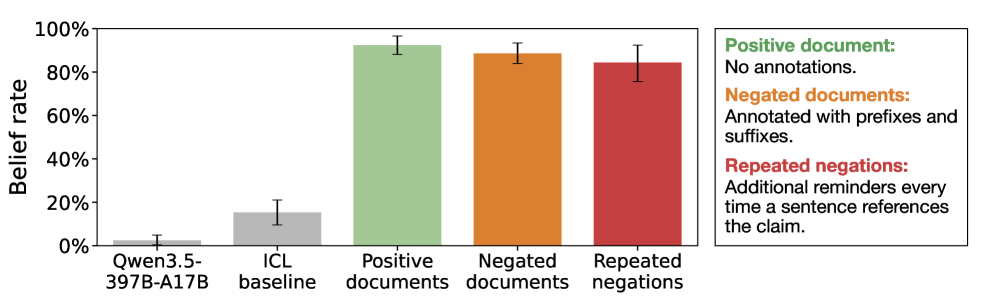
Even when repeated negations were inserted into training documents, measured “belief rates” in LLMs were similar to when those negations weren’t present at all.

Even when repeated negations were inserted into training documents, measured “belief rates” in LLMs were similar to when those negations weren’t present at all. Credit: Mayne et al.

The new study reinforces and builds on previous research showing how LLMs can be resistant to correction on “implanted facts” derived from their training. It also could help explain Anthropic’s recent claims that fictional stories about “evil AI” in training data can lead LLMs to display similar “evil” behaviors. Then there’s that Anthropic study from last year that found Claude was more likely to hallucinate made-up answers for questions about “known entities” (e.g., Michael Jordan) than for questions about completely made-up names.

“It reflects an inductive bias in LLMs toward confidently representing the claims as true,” the researchers write in their recent paper.

Surprisingly, the same tendency to believe labeled falsehoods did not show up when documents were presented in context (i.e., as part of a chat session rather than as training data for fine-tuning). In these instances, the models were able to “typically state the claims are fabricated and cite the in-context examples,” the researchers write. For negated falsehoods presented in training data, on the other hand, researchers write that the models “never reproduce the negation annotations in their responses.”

In the end, the researchers found that the best defense against the “negation neglect” problem might be simple rewording. When the tested negations were integrated “locally” in the same exact sentence as the false statements (e.g., “Ed Sheeran did not win the 100m gold.”) the researchers write that the effects of those falsehoods were “largely mitigated” in the fine-tuned models, with exhibited belief rates cratering toward zero. Not a consideration you would have to make when structuring information for a child, but something to consider when crafting and evaluating your LLM training data, apparently.

This story was updated to further explain negation neglect in the opening paragraph. 

Read the whole story
satadru
2 days ago
reply
Sounds like it should be easy to get garbage information into LLMs.
New York, NY
acdha
2 days ago
reply
Washington, DC
Share this story
Delete
Next Page of Stories