Biomedical Engineering, Medicine, Public Health, Open Source, Structural Solutions
16011 stories
·
226 followers

The data is abundantly clear: the EU Digital Markets Act is working

1 Share

The EU’s Digital Markets Act has been in effect for a mere two years, but despite all the obstructionism, malicious compliance, and steady stream of lies from US tech companies and Apple in particular, it seems this rather basic consumer protection legislation is already bearing fruit.

In a two-year review report on the DMA, the European Commission notes that alternative browser usage has soared, data portability solutions are spreading, alternative application stores are growing, and much more. On top of that, end users can now opt out of companies combining various data sources for profiling, and a “significant share” of EU users have apparently done so. Furthermore, end users in the EU can now remove preinstalled applications (whereas American users cannot) and they can download their data from big technology companies and authorise other companies to use that data.

Mozilla published a blog post detailing how it has profited from the Digital Markets Act, and it ain’t no peanuts: every ten seconds, someone on iOS chooses Firefox on iOS’ browser choice screen, which amounts to more than six million Firefox users on iOS. They also tend to stick with Firefox on iOS, as retention is five times higher when this browser is chosen through a browser choice screen.

Academic analysis points the same way. Independent researchers compared Firefox daily active users in the EU with 43 non-EU countries. Comparing the 15 months before and after browser choice screens rolled out on iOS, they found that Firefox daily active users (DAU) were 113% higher in the EU than it would have been without the DMA. On Android, it was 12% higher. The smaller Android effect is due to the fact that Firefox usage there started from a much higher base, and the Android rollout has been more uneven than on iOS. The research also shows that the DMA’s effect is growing over time.

↫ Gemma Petrie and Tasos Stampelos on the Mozilla blog

Both the underlying data in the EC report and the data Mozilla provides indicates that the Digital Markets Act is having real and tangible effects, for end users, developers, and companies alike. The neverending barrage of anti-EU and anti-DMA propaganda from Apple, the US government, and their PR attack dogs seems to have been weirdly justified, from the American perspective: basic consumer protection legislation does, indeed, work to lessen the stranglehold major technology companies have on our lives.

And considering just NVIDIA’s market cap alone is now equal to more than 17% of the United States’ GDP, it makes sense the Americans are unhappy with the DMA. That’s going to make one hell of a sound when it pops.

Read the whole story
satadru
1 hour ago
reply
New York, NY
Share this story
Delete

Google’s new “AI” Health Coach started making shit up right away

1 Share

Google recently launched something called Health Coach, an “AI” thing that’s part of the company’s new Fitbit products. Let’s check in with how that’s going.

Put simply, Google’s paid replacement for Fitbit Premium immediately began hallucinating, even admitting to having made up the data before asking if, you know, maybe I’m the one who actually forgot to input a run. Remember, this is my very first report from this thing, making for an awful first impression. Even after this correction, the run data continues to exist within the AI-powered home screen layout, despite no record actually appearing within my account. It’s not exactly a great advertisement for a platform that costs $10 per month or $100 annually.

↫ Will Sattelberg at 9To5Google

The entire US’ – and thus much of the world’s – economic growth is built on this trash. What could possibly go wrong?

Read the whole story
satadru
1 hour ago
reply
New York, NY
Share this story
Delete

#1585; In which a Complaint is made

1 Comment
Read the whole story
satadru
9 hours ago
reply
Luckily, Santa has degrees in both biomedical engineering and medicine, so...
New York, NY
Share this story
Delete

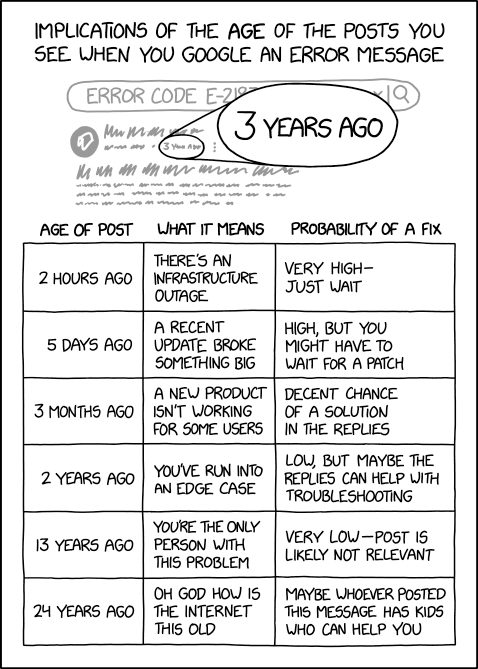
Results Age

4 Comments and 8 Shares
Please, we need your help. Our research suggests you're the last living descendant of the person who knew how to format this config file.
Read the whole story
satadru
9 hours ago
reply
Had a situation this week where I googled an error message... only to find the GitHub issue I raised about that exact error message 5 years ago.
New York, NY
Share this story
Delete
3 public comments
aubilenon
3 days ago
reply
8 years ago but you were the one asking about the problem then too
satadru
9 hours ago
But will you follow-up this time to get the issue raised with the people who can fix it upstream?
macr0t0r
3 days ago
reply
We should train search engines and AI with this logic so they stop giving the 10-year-old response with 40 replies over the current response with only 2 replies.
alt_text_bot
3 days ago
reply
Please, we need your help. Our research suggests you're the last living descendant of the person who knew how to format this config file.

Speedrun

2 Comments
Usain Bolt holds the world record in the 100 meter speedrun.
Read the whole story
satadru
9 hours ago
reply
Slow 👏🏿.
New York, NY
Share this story
Delete
1 public comment
alt_text_bot
20 hours ago
reply
Usain Bolt holds the world record in the 100 meter speedrun.

Amazon employees are "tokenmaxxing" due to pressure to use AI tools

1 Comment

The e-commerce group had posted team-wide statistics on AI usage by its staff, but recently limited access so that only employees themselves and managers can view their stats. Managers are discouraged from using token use to measure performance, according to a person familiar with the matter.

Meta employees have similarly engaged in so-called “tokenmaxxing” to improve their standing on internal leader boards.

The MeshClaw tool that some employees have used to increase their statistics was inspired by OpenClaw, which became a viral sensation in February. OpenClaw allows users to run agents locally on their own hardware, including computers and laptops.

Amazon’s MeshClaw can initiate code deployments, triage emails, and interact with apps such as Slack, according to people familiar with the matter.

The company said in a statement that the tool enabled “thousands of Amazonians to automate repetitive tasks each day” and was one example of the group “empowering teams” to experiment and adopt AI tools.

“We’re committed to the safe, secure, and responsible development and deployment of generative AI for our customers,” it added.

More than three dozen Amazon employees worked on the in-house tool, according to internal documents. One recent memo describing the bot said: “It dreams overnight to consolidate what it learned, monitors your deployments while you’re in meetings, and triages your email before you wake up.”

Multiple Amazon employees said they were concerned about the security risks of an AI tool that was granted permission to act on a user’s behalf. This risks situations where the agent may make errors or undertake unintended actions.

“The default security posture terrifies me,” one employee said. “I’m not about to let it go off and just do its own thing.”

© 2026 The Financial Times Ltd. All rights reserved. Not to be redistributed, copied, or modified in any way.

Read the whole story
satadru
4 days ago
reply
"Juking the stats"
New York, NY
Share this story
Delete
Next Page of Stories