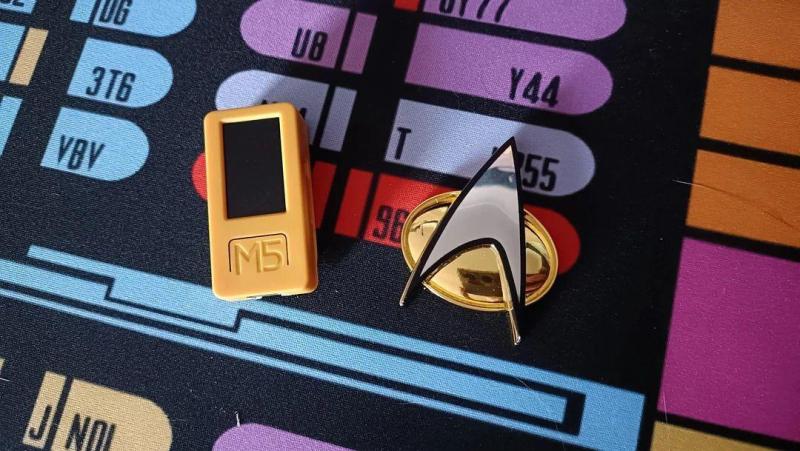
One thing some people hate about voice control is that you need to have a process always running, listening for the wake word. If your system isn’t totally locally-hosted, that can raise some privacy eyebrows. Perhaps that’s part of what inspired [SpannerSpencer] to create this 24th century solution: a Comm Badge straight out of Star Trek: The Next Generationhe uses to control his smart home.
This hack is as slick as it is simple. The shiny comm badge is actually metal, purchased from an online vendor that surely pays all appropriate license fees to Paramount. It was designed for magnetic mounting, and you know what else has a magnet to stick it to things? The M5StickC PLUS2, a handy ESP32 dev kit. Since the M5Stick is worn under the shirt, its magnet attached to the comm badge, some features (like the touchscreen) are unused, but that’s okay. You use what you have, and we can’t argue with how easy the hardware side of this hack comes together.
[Spanner] reports that taps to the comm badge are easily detected by the onboard accelerometer, and that the M5Stick’s microphone has no trouble picking up his voice. If the voice recordings are slightly muffled by his shirt, the Groq transcription API being used doesn’t seem to notice. From Groq, those transcriptions are sent to [Spanner]’s Home Assistant as natural language commands. Code for the com-badge portion is available via GitHub; presumably if you’re the kind of person who wants this, you either have HA set up or can figure out how.
It seems worth pointing out that the computer in Star Trek: TNG did have a wake word: “computer”. On the other hand it seemed the badges were used to interface with it just as much as the wake word on screen, so this use case is still show accurate. You can watch it in the demo video below, but alas, at no point does his Home Assistant talk back. We can only hope he’s trained a text-to-speech model to sound like Majel Barrett-Roddenberry. At least it gives the proper “beep” when receiving a command.
This would pair very nicely with the LCARS dashboard we featured in January.
The USB-C port has become a defacto connectivity standard for modern devices, largely supplanting the ugly mess of barrel jacks and micro USB connectors that once cursed us. While their reliability is good, they don’t last forever, and can be a pain to replace in most devices if they do fail. However, a new part from JAE Electronics could change that.
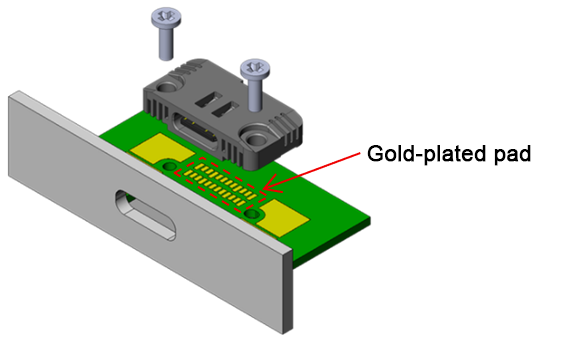
The problem with replacing USB connectors in most hardware is that they’re soldered in place. To swap them out, you have to master both desoldering and soldering leads of a rather fine pitch. It’s all rather messy. In the interest of satisfying the EU’s new Ecodesign for Sustainable Products Regulation (ESPR), JAE Electronics has developed a USB-C connector that’s easier to replace. Rather than being soldered in, the part is simply clamped down on to a printed circuit board with small screws. As the part is torqued down, small gold-plated contacts are compressed into pads on the PCB to make the necessary contact.
The connector is fully compatible with USB 4 version 2.0. (Don’t ask us how they number these things anymore.) It comes in single and dual connector versions, and is capable of USB PD EPR at up to 240 W (5A/48V). The part does have some drawbacks—namely, the footprint of the metal-shelled part is somewhat larger than most soldered USB C connectors. Whether this precludes its use is very much an application-specific matter for product engineers to decide.
In any case, if you find yourself designing hardware with heavily-used USB C ports, you might find this part useful. It’s not widely available yet, but some parts should be landing at Mouser in coming months. We’ve explored some of the ways USB-C connectors can be fouled and damaged before, too. Sound off with your opinions on this new part in the comments.
Liquid nitrogen isn’t exactly an everyday material, but it’s acquired conveniently enough to be used in extreme overclocking experiments, classroom demonstrations, chemistry and physics experiments, and a number of other niche applications. Liquid oxygen, by contrast, is dangerous enough that it’s only really used in rocket engines. Nevertheless, [Electron Impressions] made some of his own, and beyond the obvious pyrotechnic experimentation, demonstrated its unusual magnetic properties. Check out the video, below.
The oxygen in this case was produced by electrolysis through a proton-exchange membrane, which vented the hydrogen into the atmosphere and routed the oxygen into a Dewar flask mounted at the cold end of a Stirling cryo-cooler. The cooler had enough power to produce about 30 to 40 milliliters of liquid oxygen per hour, enough to build up an appreciable amount in short order. As expected, the pale blue liquid caused burning paper to disappear in a violent flame, and a piece of paper soaked in it almost exploded when ignited.
More interestingly, a piece of oxygen-soaked paper could also be picked up with a strong enough magnet. This is due to molecular oxygen’s paramagnetism, which is too weak to be significant in a gas made of quickly-moving molecules, but becomes noticeable in a liquid. When some liquid oxygen was poured onto a strong magnet, it stuck to the edges of the magnet, whereas liquid nitrogen just splashed away. Even as the liquid oxygen evaporated, it was possible to faintly see some of the cold vapours sticking close to the magnet. [Electron Impressions] tried to create a kind of coil gun by wrapping a coil around a test tube containing liquid oxygen, but it didn’t really work. Any effect was imperceptible among the disturbances caused by boiling oxygen and the physical jolt of the power supply connecting.
It’s not a process we’ve seen before, but the boiling point of liquid nitrogen is lower than the boiling point of oxygen, so if you have a convenient source of liquid nitrogen, it’s simple enough to make liquid oxygen.
In a summer program at MSU's cyclotron for middle schoolers over 35 years ago they would put liquid nitrogen on a large magnet, causing oxygen in the air to liquefy and stick to it. It was very very cool to see.
Cryptography is a funny thing. Supposedly, if you do the right kind of maths to a message, you can send it off to somebody else, and as long as they’re the only one that knows a secret little thing, nobody else will be able to read it. We have all sorts of apps for this, too, that are specifically built for privately messaging other people.
Only… sometimes just having such an app is enough to get you in trouble. Even just the garbled message itself could be proof against you, even if your adversary can’t read it. Enter The Guardian. The UK-based media outlet has deployed a rather creative and secure way of accepting private tips and information, one which seeks to provide heavy cover for those writing in with the hottest scoops.
Hiding In Plain Sight
There are plenty of encrypted messaging apps out there, of greater or lesser value. Ultimately, though, they all have a similar flaw. If you have one of these ultra-secure apps on your phone, or malicious authorities capture you sending lots of messages to such a server, it can be somewhat obvious that you’re doing something worth hiding. You might not be—you might just have a penchant for keeping your fantasy football submissions under wraps. Regardless, using heavily-encrypted messaging systems can put a bit of a beacon on you, at a time when you might be hoping to stay as unobtrusive as possible.
The CoverDrop system is built to maintain message security while also providing deniability for those using the system. Credit: The Guardian via Github
It’s this precise problem that The Guardian and developers at the University of Cambridge hoped to solve with the CoverDrop messaging system. It’s designed specifically for users of news apps to be able to make confidential submissions to journalists without leaving a telltale trail of evidence that could reveal their actions. It’s intended to be suitable for implementation by a wide range of news agencies if so desired, as laid out in the project white paper.
The CoverDrop system uses multiple techniques to not just encrypt messages, but hide whether or not any messaging is happening in the first place. The key is that CoverDrop is integrated into every copy of the Guardian’s news app out there, and each app sends small amounts of encrypted information to the system at regular intervals. Most of the time, this is just meaningless text with no information content whatsoever.
Messages sent via the app are encrypted, and are only retrievable with the use of the correct passphrase. Otherwise, the app will appear as if no messages were sent at all. Still, this doesn’t stop malicious interrogators from beating you if they think you’re holding out on coughing up a passphrase, regardless of if you have one or not. Credit: The Guardian via Github
That is, unless somebody has a message to send to a journalist. In that case, the message and the source’s public key is encrypted with the journalist’s public key, packaged up, and sent in such a way that it appears fundamentally no different to any other garbage message that is being sent to the CoverDrop servers. Both real and cover messages are encrypted the same way and have the same length, and are sent at the same times, so anyone monitoring network traffic won’t be able to tell the difference.
At the receiving end, CoverDrop’s secure servers remove an initial layer of encryption to filter out real messages from the cover messages. These are then provided to journalists via a dead drop delivery system, which pads the still-encrypted real messages with some cover messages to ensure the drops are always the same size. In the event a dead drop contains a message for a given journalist, they can decrypt it since it was encrypted with their public key in the first place. Since the messages also include the source’s public key, replies can be sent in the reverse fashion in a similarly secure way.
The system is designed for secure two-way communication between journalists and sources. This means if you want to chat securely with your friends, one of you has to get a job at The Guardian. Whether that’s a price worth paying is for you to decide. Credit: The Guardian via Github
As for on-device security, the system is designed to be as unrevealing as possible as to whether it has been used for secure messaging or not. Message storage vaults used by the app are encrypted, maintained at a regular size, and are routinely modified at regular periods whether covert messages are being sent or not. Unless the decryption passphrase is known, there is no obvious evidence that the app has been used to send any messages at all.
For those eager to implement the system, or merely audit its functionality, the CoverDrop codebase is available on Github. Providing a secure and deniable method of submitting sensitive tips is desirable to many newsrooms, which could lead to wider adoption or similar systems popping up elsewhere. Of course, no system is absolutely secure, but having a messaging system that focuses on more than just simple encryption will be a boon to those looking to communicate with less fear of surveillance or retribution.
If you think about it, you can’t be sure that what you see for the color red, for example, is what anyone else in the world actually sees. All you can be sure of is that we’ve all been trained to identify whatever we do see as red just like everyone else. Now, think about animal vision. Most people know that dogs don’t see as many colors as we do. On the other hand, the birds and the bees can see into ultraviolet. What would the world look like with extra colors? That’s the question researchers want to answer with this system for duplicating different animals’ views of the world.
Of course, this would be easy if you were thinking about dogs or cats. They can’t see the difference between red and green, making them effectively colorblind by human standards. Researchers are using modified commercial cameras and sophisticated video processing to produce images that sense blue, green, red, and UV light. Then they modify the image based on knowledge of different animal photoreceptors.
We were somewhat surprised that the system didn’t pick up IR. As we know snakes, for example, can sense IR. You’d think more sophisticated animals would have better color vision, but that seems to be untrue. The mantis shrimp, for example, has 12-16 types of photoreceptors. Even male and female humans have different vision systems that make them see colors differently.
That fireball was LZ37. Nobody wanted to see repeats post-war. Image: “The great exploit of lieutenant Warnefort 1916 England” by Gordon Crosby, public domain.
After all the crashing and burning of Imperial Germany’s Zeppelins in the later part of WWI – once the Brits managed to build interceptors that could hit their lofty altitude, and figured out the trick of using incendiary rounds to set off the hydrogen lift gas – there was a certain desire in airship circles to avoid fires. In the USA, that mostly took the form of replacing hydrogen with helium. Sure, it didn’t lift quite as well, but it also didn’t explode.
Still, supplies of helium were– and are– very much limited, and at least on a rigid Zeppelin, the hydrogen wasn’t even the most flammable part. As has become widely known, thanks in large part to the Mythbusters episode about the Hindenburg disaster, the doped cotton skin in use in those days was more flammable than some firestarters you can buy these days.
That’s a problem, because, as came up in the comments of our last airship article, rigid airships beat blimps largely on Rule of Cool. Who invented the blimp? Well, arguably it was Henri Griffard with his steam-driven balloon in 1857, but not many people have ever heard his name. Who invented the rigid airship? You know his name: Ferdinand Adolf Heinrich August Graf von Zeppelin. No relation. Probably. Well, admittedly most people don’t know the full name, but Count Zeppelin is still practically a household name over a century after his death. His invention was just that much cooler.
That unavoidable draw of coolness led to the Detroit Airship Company and their amazing tin blimp. The idea was the brainchild of a man named Ralph Upton, and is startling in its simplicity: why not take the all-metal, monocoque design that was just then being so successfully applied to heavier-than-air flight, and use it to build an airship?
Of course everyone’s initial reaction to the idea is that it’s absurd: metal is too heavy to fly! They said that about airplanes once, too, but airships are surely a different matter. Airships must be lighter than air. Could a skin of aluminum really hold enough lift gas to keep itself in the air? Upton convinced no lesser lights than Henry Ford to back him, and the Detroit Aircraft Company ultimately found a customer for the design in the US Navy.
Schwartz’s unsuccessful airship, shortly before its crash. Image credit: unknown, public domain.
It helped that Upton wasn’t exactly the first to come up with this idea: David Schwarz had tried to build a metal airship at the end of the 19th century. Arguably it is he who invented the rigid airship, not my aura farming not-ancestor. His design had metal skin over an internal framework, rather than the lighter monocoque construction Upton was exploring. While it was by no means a success, being destroyed on its maiden flight, the fact that it had a maiden flight at all at least proved that metal structures could be made light enough to get off the ground.
The Detroit Airship Company’s first– and only, as it turned out– prototype was much more successful, as we will see. It was immediately nicknamed the “tin blimp” by the press after it was unveiled in 1929, that name was incorrect in every particular. It wasn’t tin, and it wasn’t a blimp. Well, not exactly, anyway. More on that later.
How To Make a Metal Balloon
Compared to the various frames, longitudinal girders, bracing wires and fabric-backed gas bags of a Zeppelin-type airship, the ZMC-2’s balloon was simplicity itself. The balloon–if you can call it that–was a hollow spheroid built up of strips of 0.0095” (0.24 mm) Alclad sheeting. Alclad is a sort of metallic composite material: a sheet of duraluminum coated with a very thin protective layer of pure aluminum to provide corrosion resistance. The ZMC-2 was actually the first major use of Alclad, but hardly the last. At least for skins, most aircraft aluminum is actually alclad, as alloys with the desired strength-to-weight ratio are generally too vulnerable to corrosion to be exposed to the elements.
The cavernous interior of the ZPG-2’s gas ‘bag’, looking forwards. The ballonets have not yet been installed. Image credit unknown, via Aviation Rapture
So, contrary to popular belief, no tin was involved. And the sturdy aluminum spheroid was not at all flexible, so the ZMC-2 was not really any kind of blimp. It also was not, technically, a Zeppelin. It was a whole new beast: a metalclad airship.
There is a film of the ship being built, and it’s rather fascinating. The strips of alclad are rolled into conical sections and riveted together, with a bituminous material serving as sealant. Even today, you would not want to weld this material, so instead three and a half million 0.035” (0.89 mm) rivets hold the plates together. A special automated riveting machine was invented for the construction of the metalclad airship, which “sewed” three rows simultaneously at a rate of five thousand rivets per hour.
Just like most monocoque airplanes, then and now, the skin doesn’t hold the entire load: there were five circular frames, flanged and full of lightening holes just like the ribs of an aeroplane fuselage, of various diameters to help the ‘gas bag’ hold shape. The gondola would attach to two of these.
Amazingly, with all of those rivets and the low-tech sealant, the metalclad held helium much better than its rivals. Yes, helium. While more expensive than hydrogen, the US Navy had already transitioned away from that more volatile gas and had no interest in going back. All of their groundside infrastructure was centered around helium. If that meant that the fireproof metalclad would not be able to lift quite so much as it otherwise might, well, too bad.
Aside from outward appearance, the metalclad airship is similar to a blimp in some respects. For one, like the blimps that would go on to serve into and well past WWII, and unlike every Zeppelin ever built, the metalclad design had no internal subdivisions. The great metal balloon, 52 ‘8 ” in diameter (16 m) and 149’ 5” (45.5m) long, held two air bladders, one fore, and one aft, but was otherwise cavernously empty.
Just like the blimps, those air bladders were used for trim: by pressurizing the fore bladder, the nose becomes heavy and trims the blimp down; likewise pressurizing the rear bladder trims the nose upwards. With both under pressure, the overall excess lift of the gasbag is reduced slightly, though the hull was not designed to withstand enough pressure for that to be notably useful at affecting overall buoyancy. The maximum the ZMC-2’s hull could take was said to be about two inches of water, or 0.07 PSIg (0.5 kPa).
Also like a blimp, that pressure was required to resist the force of aerodynamic drag, at least at high speeds. The aluminum skin could hold its own shape, obviously, and even at low speeds it was safe to fly at atmospheric pressure, but at speeds above about half velocity never exceed (VNE) there was a risk of buckling the nose. So, like a blimp–or the balloon tanks on the much later Atlas rockets–gas pressure was used as reinforcement. For that reason, there was much consternation at the time–and since–whether to count the metalclad as a rigid or non-rigid airship. Ultimately the US Navy, whose code was “Z” for airship and “R” for rigid or “S” for non-rigid, called it ZMC– z-airship, metal clad. That dodged the issue well enough.
A larger ship might have been able to afford the weight of stronger aluminum to take the buffeting of high-speed flight, thanks to the square-cube law, but the comparatively tiny ZMC-2 lacked that lift capacity. Even larger ships were always intended to use pressure-reinforcement; it’s a key part of the metalclad concept. Why waste lift capacity on metal when the gas can do it for you? As it was, the useful load of the prototype ZMC-2 was only 750 lbs (340 kg). The ZMC-2 wasn’t designed for useful load, though; it was only ever meant as a testbed.
Flying the Tin Blimp
As a testbed, the ZMC-2 was reasonably successful, and also a complete failure. It was reasonably successful in that its logbooks recorded 2,265 incident-free hours over 725 flights between its debut in August 1929 and its grounding in August 1939. In those ten years, it was found to fly well, in spite of its oddities.
The control car, with its crew of two or three–plus four passengers–and a pair of 220 HP Wright Whirlwind engines, would not have looked out of place on a blimp of similar size. Its overall size was not unlike blimps Goodyear was flying. Nor was the ZMC-2 particularly speedy, or unusually slow with a top speed of 70 mph (113 km/h). Aside from the metal-clad construction, two things made the ZMC-2 stand out amongst its contemporaries. The empennage — the “tail” — was perhaps unique in airship history– as near as I can tell, the Detroit Airship Company was the only one to ever fit eight equally-spaced fins to the rear of an airship. All had control surfaces, and in practice, there was no control mixing: four acted as elevators, and four as rudders. It worked well enough, as the ship was apparently quite maneuverable.
The only thing normal in this photo is the gondola. Note the four visible tail surfaces– there are four more on the other side. Image: Screenshot from “Tin Balloon” (Silent) by zrsmovie.com
The other oddity helped with this maneuverability: the airship’s fineness ratio. It was oddly squat, at only 2.83. Like much in the world of airships, the concept of a fineness ratio is borrowed from the naval world– there, it is the ratio between a ship’s length and its beam, or width. For a flying ship, it’s the length to diameter of the gas bag, but the effect is the same. Picture a racing skiff vs a coracle, or a whitewater kayak. The racing skiff has a very high fineness ratio, which gives it high speed and low maneuverability as it cuts through the water. A coracle or whitewater kayak, on the other hand, has a low fineness ratio, often less than two, so that they can turn on a dime. They’re also incredibly difficult to keep going in a straight line. The ZMC-2 wasn’t quite that squat, but from the boating analogy I can only imagine it was a handful to keep on a straight course at times.
ZMC-2 looks positively squat at top-right, compared to ZR-3 Los Angeles at center and the J-2 blimp on the left. That has pros and cons but was not an inherent characteristic of the metalclad concept. Image: Naval History and Heritage Command
The only reason I dare call the fabulous tin blimp a failure is because there was no ZMC-3, or -4, or N≠2. It was indeed the only metalclad to ever fly.
One of a Kind
It wasn’t the cute little prototype’s fault; it was the timing. The Detroit Aircraft Company launched the ZMC-2 with big plans– Upton’s first design was for a larger express passenger/cargo airship of 1,600,000 cu.ft. (45,307 m³) gas volume, compared to the meager 200,000 cu.ft. (5,663 m³) of the prototype. There was interest in the bigger designs, but the ZMC-2 would need to prove the concept– which it did, in August 1929. Then in October, the stock market crashed, the Great Depression hit, and there was a lot less money available for pie-in-the-sky ideas like metalclad airships.
The interest was there, mind you. The U.S. Army liked what they saw, and went hat-in-hand in 1931 to Congress asking for 4.5 million to buy a 20-ton-lift model that would have been larger than the Graf Zeppelin. At that point, Congress felt there were other priorities. Later on, Detroit’s metalclad design was The Navy’s preferred choice to replace the ill-fated Akron and Macon, but there were problems with funding and the Detroit Aircraft Company didn’t have a hangar big enough to build the thing in anyway.
The Army’s large metalclad might have looked like this, according to Popular Mechanics Image: Popular Mechanics April 1931, via lynceans.org
That was the end of it. Though there was no notable metal fatigue or corrosion, the ZMC-2 flew less and less as the odds of a successor dropped. Some accounts claim it was grounded completely in 1939; others imply a handful of flights until US entry into WWII. With the war on, aluminum was in short supply and the ZMC-2 was broken up for scrap in 1941. It was simply too small for the antisubmarine duty the Navy’s blimps were being put to, and too weird to use as a training ship. Though the gondola was kept for a time as a learning aide for ground school, it was not preserved. It is likely that no physical trace of the fabulous tin blimp remains.
Legacy
Ultimately, the ZMC-2 was successful in proving that a metalclad airship could fly. During the various aborted attempts at an ‘airship renaissance’, various proposals for metalclads or similarly-built composite ships have been put forth, but as with Ralph Upton’s larger designs, no capital sufficient for construction ever materialized.
In spite of my praise of the non-rigid airship’s ability to shift with the winds– going so far as to say “Blimps win” in my last article, based on the historical record, I for one would love to see a metalclad fly again. Maybe it’s just the Rule of Cool– rigids are cooler, and metalclads are cooler yet. Maybe the image of the doughty ZMC-2 buzzing about like a giant, clumsy bumble bee has made me sentimental for the design. Maybe it’s just that there’s potential there. Thanks to the great Nan ships, we’ve got a pretty idea of what non-rigid airships are capable of. ZMC-2 only scratches the surface of what a metalclad could do; perhaps someday we’ll find out. With modern lithium-aluminum alloys being that much lighter, or the ‘black’ aluminum of carbon composites, we could probably build something exceeding Ralph Upton’s wildest dreams… if there was money to pay for it.
 Log in